DO NOT GIVE OUT YOUR INFORMATION! We will never contact you asking for your Online Banking username and password, debit card number or your PIN.
Cryptocurrency, or “crypto,” has surged in popularity, with digital currencies like Bitcoin gaining widespread use. However, this popularity has also made it a target for scammers, leading to consumers losing over $1 billion to crypto scams in the first half of 2022, as reported by the Federal Trade Commission (FTC).
The appeal of crypto for scammers lies in its decentralized nature, the irreversible nature of transactions and the general lack of understanding among most people about how crypto operates. The absence of a centralized authority to flag suspicious transactions makes it an attractive playground for fraudsters.
Scammers employ various methods to initiate contact with potential victims, such as email phishing, SMS text messages (smishing), phone calls, packages and social media. They often use personal information to target victims or even imitate someone known to the victim. One common tactic is to promise unrealistically high returns on crypto investments.
The process involves instructing victims to convert US dollars into Bitcoin and send it to a specific digital address, frequently using Bitcoin ATMs for the transaction. Once the funds are transferred, the irreversible nature of crypto transactions leaves victims with no recourse.
To avoid falling victim to crypto scams, consumers are advised to exercise caution when dealing with cryptocurrency transactions. Running transactions through professionals like banks, CPAs or tax professionals can help verify legitimacy. Additionally, individuals should not send money on behalf of others and extra scrutiny is needed for checks received via non-USPS mail services.
If a situation seems suspicious, consulting trusted advisors is crucial. Scammers often employ tactics like repeated contact, harassment and pressure to prevent victims from seeking advice or reporting the situation to authorities.
In case you have already fallen victim to a scam, steps can be taken to mitigate further harm. Victims should contact the FBI through ic3.gov to report identity theft, reach out to the bank’s fraud department, and remain vigilant against future scam attempts.
Overall, the rise in crypto popularity has brought about a parallel surge in scams, making it imperative for consumers to educate themselves, exercise caution and seek professional advice before engaging in cryptocurrency transactions.
As winter approaches and holiday travel plans take center stage, winter wanderers must be on high alert for potential scams lurking in various forms. From deceptive emails to cunning calls and enticing social media posts, scammers are ramping up their efforts to exploit the joyous spirit of the season. Here’s how to navigate the winter wonderland of travel without falling prey to fraud.
Social Media
Social media, a hub for festive cheer, is also a breeding ground for travel scams. Criminals imitate well-known hotels and resorts online, but their sites include misleading information, such as fake hyperlinks and phone numbers. Eager holiday-goers may find themselves making payments for dream getaways that exist only in the virtual realm leaving them empty-handed and out of pocket.
Robocalls
Robocalls, often associated with automated holiday greetings, can also mask sinister intentions. If your phone rings with an automated message, especially regarding travel, the safest bet is to hang up promptly. Legitimate travel agencies steer clear of robocalls, making them a clear red flag for potential scams.
Allow your winter travel experiences to be filled with pleasure and amazement, rather of the traps of frauds. Stay vigilant, stay informed, and ensure your winter holidays are as magical as they should be.
Booking Sites Before booking winter travel offers, diligent research on the company is essential. While reviews and ratings provide insights, individual needs differ. Beware of seemingly irresistible deals, such as complimentary airline tickets, as scammers use these as bait to hook unsuspecting victims.
Cancellation Policies
Protect your winter escapades by always securing a receipt and understanding cancellation policies before confirming any reservations. Having these policies in writing serves as a crucial record should disputes arise later.
Wi-Fi Connections
As snow blankets landscapes, scammers attempt to cover their tracks with fraudulent schemes. Regularly monitor your financial accounts for any suspicious activity. Embrace the convenience of online banking but do your best to steer clear of public Wi-Fi networks that could compromise your security. Because they are vulnerable, public Wi-Fi networks present a serious threat. Visit RCB Bank Online Banking Tools here.
Planning a winter getaway? Alert your bank in advance. Provide details about your destinations and travel dates to ensure smooth financial transactions without unexpected disruptions.
Should the unfortunate happen and you find yourself entangled in a travel scam, swift action is imperative. Contact our RCB Bank support team at 1.855.226.5722 on weekdays between 8:00 a.m. and 6:00 p.m. CST. For weekend assistance, dial 1.877.361.0814 on Saturdays from 8:00 a.m. to 4:00 p.m. and Sundays from 8:00 a.m. to 12:00 p.m. (excluding Federal Holidays). Additionally, contribute to combating fraud by filing a complaint with the FBI at ic3.gov.
Opinions expressed above are the personal opinions of the author and meant for generic illustration purposes only. RCB Bank, Member FDIC.
Aspiring homeowners are no strangers to the challenges of securing mortgage approval, and in this quest, one often-overlooked factor emerges as a crucial element —the elusive credit score.
In the world of real estate, where dreams of owning a home come with a price tag, understanding the connection between credit scores and mortgage approval rates can be a game-changer. Your credit score is not only a number representation; it has the ability to significantly impact your ability to get a mortgage and become a homeowner.
Your credit score is more than just a score—it’s a passport to your homeownership journey. There is a direct link between higher credit scores and the likelihood of having that mortgage application stamped with approval.
The industry has long acknowledged credit scores as an essential metric of financial trustworthiness. Yet, what many may not realize is the extent to which lenders rely on this three-digit number to gauge an individual’s financial habits and risk potential.
Digging into the intricacies, it becomes apparent that a higher credit score not only secures better interest rates but significantly boosts the odds of getting that coveted nod from lenders. In a landscape where competition for mortgage approvals is fierce, understanding the nuances of credit scores becomes a strategic advantage.
What does this mean for the average home seeker? It’s a call to action, urging individuals to be proactive in cultivating a credit profile that appeals to lenders. Timely bill payments, debt reduction, and vigilant credit report monitoring are highlighted as key steps in this journey towards creditworthiness.
Schedule an appointment with an RCB Bank Mortgage representative today for more information while you search for your dream home. You can also take advantage of RCB Bank’s Loan Promotion to Save $500 by December 31, 2023. Click Save500 today!
Opinions expressed above are the personal opinions of the author and meant for generic illustration purposes only. Offer available for most purchases and refinances. With approved credit on RCB Bank Mortgage secondary market loans locked between October 1, 2023 and December 31, 2023. Must meet minimum loan and program underwriting requirements. Lender credit must be used toward borrower closing costs. Not redeemable for cash or down payment funds. This offer is not valid with any other RCB Bank Mortgage incentives, promotions or discounts. OHFA Bond and 5/5 ARM products are not eligible for promotional credit. This offer is subject to change or terminate without notice. Other loan terms and restrictions apply. RCB Bank is an Equal Housing Lender. NMLS #798151 and Member FDIC
As the real estate market continues to evolve, prospective homebuyers are faced with various choices and decisions. One of the pivotal considerations in the homebuying process is understanding the distinction between Mortgage Pre-Approval and Pre-Qualification. To shed light on this often-confusing subject, experts weigh in to help homebuyers make informed decisions.
Mortgage pre-approval and pre-qualification are frequently used interchangeably, but they carry different implications and serve distinct purposes in the home financing journey. According to financial experts, the differences lie in how thoroughly each process is evaluated.
Mortgage Pre-Qualification
Mortgage pre-qualification is the preliminary step in the home loan process. It involves a basic assessment of an individual’s financial situation based on self-reported income, debts, and credit. Lenders use this data to provide a rough estimate of the loan amount a borrower might be eligible for. It’s a valuable starting point for those beginning their homebuying journey, offering a snapshot of their financial capacity.
Mortgage Pre-Approval
On the other hand, mortgage pre-approval is a more comprehensive and rigorous process. It requires potential homebuyers to submit detailed financial documentation, including income verification, credit history, and other relevant information. The lender then conducts a thorough analysis to determine the exact loan amount a buyer qualifies for. A pre-approval holds more weight in the eyes of sellers, as it signifies a buyer’s seriousness and financial capability. Experts emphasize the importance of obtaining a mortgage pre-approval before house hunting in today’s competitive real estate market. Pre-approval simplifies the homebuying process and gives buyers an edge in a seller’s market.
While both pre-qualification and pre-approval have their place in the home financing process, understanding the key differences empowers buyers to make informed decisions aligned with their unique circumstances. As the real estate landscape evolves, education remains a powerful tool for aspiring homeowners navigating the path to homeownership.
Schedule an appointment with an RCB Bank Mortgage representative today for more information while you search for your dream home. You can also take advantage of RCB Bank’s Loan Promotion to Save $500 by December 31, 2023. Click Save500 today!
Opinions expressed above are the personal opinions of the author and meant for generic illustration purposes only. Offer available for most purchases and refinances. With approved credit on RCB Bank Mortgage secondary market loans locked between October 1, 2023 and December 31, 2023. Must meet minimum loan and program underwriting requirements. Lender credit must be used toward borrower closing costs. Not redeemable for cash or down payment funds. This offer is not valid with any other RCB Bank Mortgage incentives, promotions or discounts. OHFA Bond and 5/5 ARM products are not eligible for promotional credit. This offer is subject to change or terminate without notice. Other loan terms and restrictions apply. RCB Bank is an Equal Housing Lender. NMLS #798151 and Member FDIC
As we conclude October’s Cybersecurity Month, it is essential to reinforce the importance of safeguarding both yourself and your financial institution, such as RCB Bank, against the ever-present threat of phone-based social engineering. This form of cybercrime preys on trust and human vulnerability, making it crucial for individuals and institutions to stay vigilant.
Here are some final tips to keep in mind:
Verify Identities: When receiving phone calls requesting sensitive information, always take the time to verify the caller’s identity. Do not be hasty in sharing personal or financial details. To ensure that you are speaking with a legitimate representative, consider calling back using official contact details that you obtained independently from trusted sources.
Educate Yourself and Others: Knowledge is a powerful weapon against social engineering. Stay informed about common tactics employed by cybercriminals who aim to deceive you over the phone. Share this knowledge with friends and family to create a network of individuals who are equally vigilant. Protecting your circle can go a long way in thwarting potential threats.
Enable Multi-Factor Authentication (MFA): One of the most effective ways to enhance the security of your personal accounts is by enabling Multi-Factor Authentication (MFA). MFA adds an extra layer of protection by requiring more than just a password for access. Whenever possible, activate MFA on your accounts to make it significantly harder for cybercriminals to breach them.
Exercise Caution Online: Be cautious about sharing personal information on social media or other online platforms. Cyber attackers often exploit the information they collect from platforms such as Facebook, Instagram, LinkedIn, and others to craft convincing schemes. Protect your personal data online to make it more challenging for malicious individuals to target you.
Report Suspicious Calls: If you ever receive a suspicious phone call related to your RCB Bank account(s), it is imperative to report it promptly to RCB Bank. You can reach us at 855.226.5722. Timely reporting of such incidents can help the bank take action to protect your accounts and investigate potential threats.
Phone-based social engineering is a persistent threat that preys on trust and human vulnerability. By understanding the tactics used by attackers and remaining vigilant, you can protect both yourself and your financial institutions. Remember that skepticism is a valuable defense, and it is essential to prioritize your security over convenience when dealing with phone calls from unknown or suspicious sources. Cybersecurity is a shared responsibility and staying informed and cautious is key to defending against these threats.
Cybersecurity is a shared responsibility. By staying informed, you can enhance your digital defenses and protect yourself from the evolving landscape of cyber threats. Remember, vigilance is your greatest asset in the battle for digital security.
If you feel or think you detect fraud or are a victim of fraud call us at 855.226.5722 or visit our website RCBBank.Bank and click on Security Center for a variety of methods to keep you and your money safe and to stay up to date.
Opinions expressed above are the personal opinions of the author and meant for generic illustration purposes only. RCB Bank, Member FDIC.
Our phones have evolved beyond mere communication devices, transforming into powerful tools for social engineering. Phone-based social engineering is a sophisticated threat that manipulates individuals into revealing confidential information or engaging in actions that compromise security. Recognizing the warning signs of these deceptive tactics is crucial to safeguard your personal and financial information.
Unsolicited Calls: One of the primary red flags is receiving unsolicited calls, especially from unknown numbers. These calls often involve requests for sensitive information or demands for immediate action. Scammers count on the element of surprise and pressure, making it essential to approach such calls with caution. Always verify the caller’s identity before sharing sensitive data or complying with their demands.
Urgency and Fear Tactics: Scammers are adept at creating a sense of urgency or fear, which puts their victims on the defensive. They aim to coerce individuals into making hasty decisions by inducing panic or stress. In these situations, taking a moment to pause and assess the call’s legitimacy is paramount. Legitimate organizations don’t resort to fear tactics to obtain your information.
Caller ID Spoofing: Another technique cybercriminals use is caller ID spoofing. Attackers can manipulate caller IDs to make it seem like they are calling from a trusted source, such as a bank or government agency. As such, never rely solely on caller ID information to determine the authenticity of a call. Always ask questions and verify the caller’s credentials independently.
Information Verification: Beware of callers who ask for personal or financial information over the phone, even if they claim to represent a legitimate organization. Legitimate institutions will typically offer alternative means of communication or verification. Only disclose your information over the phone if you know the caller’s identity.
Inconsistencies: Inconsistencies within the call, such as contradictory information or a caller who avoids answering direct questions, are often clear indicators of a scam. If something feels off during the conversation, trust your instincts. Cybercriminals rely on confusion and misdirection to achieve their goals.
Cybersecurity is a shared responsibility. By staying informed, you can enhance your digital defenses and protect yourself from the evolving landscape of cyber threats. Remember, vigilance is your greatest asset in the battle for digital security.
If you feel or think you detect fraud or are a victim of fraud call us at 877.361.0814 or visit our website RCBBank.Bank and click on Security Center for a variety of methods to keep you and your money safe and to stay up to date.
Opinions expressed above are the personal opinions of the author and meant for generic illustration purposes only. RCB Bank, Member FDIC.
In the digital age, deception has evolved into an artform, and phone-based social engineering has emerged as one of its most cunning creations. Deceptive tactics employed by these attackers often involve the impersonation of trusted entities or individuals to gain the trust of their unsuspecting victims. Let’s take a deeper dive into the intricate web of deception that these cybercriminals create.
Phishing Calls: Scammers are masters at deception who frequently disguise themselves as legitimate institutions such as banks or government agencies. Armed with a persuasive tone and a knack for manipulation, they call individuals with the intention of extracting sensitive information like Social Security numbers and credit card details. These calls, seemingly benign at first, can lead to disastrous consequences, with personal finances hanging in the balance. Phishing – What is it?
Vishing (Voice Phishing): Vishing is the darker, vocal sibling of phishing. Criminals employ a range of tactics in this malicious endeavor. They might deploy pre-recorded messages that demand immediate action or pose as authoritative figures like IT support or even law enforcement. The intention is to confuse individuals into revealing personal information or coercing them into transferring their hard-earned money into the pockets of these unscrupulous characters.
Pretexting: For attackers, crafting convincing backstories or pretexts is second nature. Impersonating a coworker in need of information for a supposed work-related task, these criminals exploit human empathy and trust. The victims, never suspecting the deceit, end up divulging sensitive data that can be exploited to the attacker’s advantage.
Impersonation: Some of these fraudsters take their deception to the next level, going to great lengths to mimic voices, mannerisms, and emotional tones. They may pose as a distressed family member or a colleague urgently seeking assistance. These emotionally charged calls prey on the victim’s sense of responsibility and sympathy, leading them down a treacherous path of deception.
Spear Phishing: In targeted attacks, these cybercriminals invest time in researching their victims. Armed with an extensive dossier, they craft highly personalized messages or calls. These communications reference specific events, acquaintances or people in the victim’s life, making them appear incredibly legitimate. This personalized touch elevates the deception to an entirely new level.
The world of phone-based social engineering is fraught with danger, where trust is leveraged as a weapon and deception reigns supreme. It’s imperative for individuals to remain cautious and verify the authenticity of callers before divulging any sensitive information, for the art of deception knows no bounds in the digital realm. A Word of Caution About Fraud
Cybersecurity is a shared responsibility. By staying informed, you can enhance your digital defenses and protect yourself from the evolving landscape of cyber threats. Remember, vigilance is your greatest asset in the battle for digital security.
If you feel or think you detect fraud or are a victim of fraud call us at 877.361.0814 or visit our website RCBBank.Bank and click on Security Center for a variety of methods to keep you and your money safe and to stay up to date.
Opinions expressed above are the personal opinions of the author and meant for generic illustration purposes only. RCB Bank, Member FDIC.
In today’s digital age, the term “cybersecurity” has become synonymous with safeguarding our digital lives. It’s the shield that guards our critical systems and sensitive information from the relentless onslaught of digital threats. Cybersecurity is the practice of protecting critical systems and sensitive information from digital attacks. These attacks can take many forms, ranging from identity theft to sophisticated scams. Understanding these threats is the first step in fortifying your digital fortress.
One of the most horrendous forms of cyberattacks is identity theft. This occurs when someone wrongfully obtains and uses your personal information, often for financial gain. Criminals may make unauthorized credit card transactions, apply for loans in your name and social security number or commit other fraudulent activities. To shield yourself from these threats, consider the following precautions:
Be vigilant: Never share personal information with unknown callers, texters, or email Verify the legitimacy of any organization before disclosing sensitive data.
Strong passwords: Avoid easily guessable passwords, such as family names or pet names. Opt for complex combinations of letters, numbers, and symbols. Refrain from writing down or storing passwords electronically, as lost devices could compromise your security.
Social media caution: Beware of oversharing on social media, as personal information gleaned from your profiles can be used against you. Visit: Online Quizzes
Regular credit checks: Obtain your free annual credit report to ensure its accuracy and detect any suspicious activities early.
Scams come in various disguises, from romance and gift card scams to fake home repair offers and even imposters posing as trusted institutions like your bank. Here’s how you can avoid falling prey to scams:
Verify charitable events: When approached with requests for donations or assistance related to disasters, always seek more information and ensure the legitimacy of the cause.
If it sounds too good to be true: Apply the age-old adage. If an offer seems suspiciously generous or unrealistic, it probably is.
Beware of contingencies: Never accept funds or sweepstakes winnings that require you to send money back. Legitimate winnings and gifts do not come with such conditions.
Cybersecurity is a shared responsibility. By staying informed and following these guidelines, you can enhance your digital defenses and protect yourself from the evolving landscape of cyber threats. Remember, vigilance is your greatest asset in the battle for digital security.
Visit our Security Center for a variety of methods to keep you and your money safe and to stay up to date.
Opinions expressed above are the personal opinions of the author and meant for generic illustration purposes only. RCB Bank, Member FDIC.
Sources: Delesline, N., & Carlton, G. (2022, June 2). What, exactly, is cybersecurity? and why does it matter?. ZDNET. https://www.zdnet.com/education/computers-tech/what-is-cybersecurity-and-why-cybersecurity-matters/
The phone has become more than just a communication tool; it has become a powerful instrument for social engineering. Social engineering via phone involves manipulating individuals into revealing confidential information or performing actions that compromise their security.
The Art of Deception
Phone-based social engineering relies heavily on deception. Attackers often impersonate trusted entities or individuals to gain their target’s trust. Here are some common tactics they employ:
Phishing Calls: Scammers often pose as legitimate organizations, such as banks or government agencies, and call individuals to extract sensitive information like Social Security numbers or credit card details.
Vishing (Voice Phishing): Vishing involves manipulating victims through voice calls. Criminals may use pre-recorded messages or impersonate authority figures, like IT support or law enforcement, to trick individuals into revealing personal information or transferring money.
Pretexting: Attackers create convincing backstories or pretexts to manipulate victims into disclosing information. For instance, they might pose as a coworker seeking information for a work-related task.
Impersonation: Some attackers go to great lengths to mimic the voices and mannerisms of others. They may impersonate a family member in distress or a colleague in urgent need of assistance.
Spear Phishing: In targeted attacks, criminals research their victims to craft personalized messages or calls. These calls may reference specific events or people in the victim’s life, making them appear more legitimate.
Recognizing the Red Flags
Protecting yourself from phone-based social engineering begins with recognizing the warning signs:
Unsolicited Calls: Be cautious of calls from unknown numbers, especially if they request sensitive information or demand immediate action.
Urgency and FearTactics: Scammers often create a sense of urgency or fear to pressure victims into complying. Always take a moment to verify the caller’s identity.
Caller ID Spoofing: Attackers can manipulate caller IDs to appear as if they are calling from a trusted source. Never rely solely on caller ID information.
Information Verification: Be wary of callers who ask for personal or financial information over the phone, even if they claim to represent a legitimate organization.
Inconsistencies: If something about the call feels off, such as inconsistent information or a caller who avoids answering questions directly, it may be a red flag.
Protecting Yourself and The Bank
To safeguard against phone-based social engineering:
Verify Identities: Always verify the caller’s identity before sharing sensitive information. Call back using official contact details obtained independently to ensure you’re speaking with a legitimate person.
Educate Yourself: Stay informed about common social engineering tactics and be vigilant. Share this knowledge with friends and family to protect them as well.
Enable Multi-Factor Authentication (MFA): Whenever possible, enable MFA on your personal accounts to add an extra layer of security.
Use Caution Online: Be cautious about sharing personal information on social media or other online platforms, as attackers may use this information against you. Be aware that attackers utilize information they gather from FaceBook, Instagram, LinkedIn, and other social media platforms.
Report Suspicious Calls: If you receive a suspicious call for your RCB Bank account(s), report it to RCB Bank’s Fraud Department immediately. (1)877.361.0814
Phone-based social engineering is a potent threat that preys on trust and human vulnerability. By understanding the tactics used by attackers and remaining vigilant, you can protect yourself. Remember that skepticism is a valuable defense, and always prioritize your security over convenience when dealing with phone calls from unknown sources.
For more information on fraud and scams please visit our Security Center to stay up to date.
Opinions expressed above are the personal opinions of the author and meant for generic illustration purposes only. RCB Bank, Member FDIC.
Sources: Risukhin, A. (2023, May 9). Social Engineering: What it is and how to protect yourself. ClearVPN. https://clearvpn.com/blog/what-is-social-engineering/
Refinancing your mortgage can be a tempting option for homeowners looking to lower their monthly payments or take advantage of lower interest rates. However, like any financial decision, there are pros and cons to consider before making the leap.
One of the biggest advantages of refinancing your mortgage is the potential to save money. If you can secure a lower interest rate than what you currently have, you could significantly reduce your monthly mortgage payments. This can free up extra cash that can be used for other expenses or savings. Additionally, refinancing can also allow you to switch from an adjustable-rate mortgage to a fixed-rate mortgage, providing stability and predictability in your monthly payments.
Another benefit of refinancing is the opportunity to tap into your home’s equity. If you’ve built up equity over time, refinancing can allow you to access that money for home improvements, debt consolidation, or other financial needs. This can be especially useful if you have high-interest debt that you want to consolidate into a lower-interest mortgage.
On the flip side, there are also some drawbacks to consider when refinancing your mortgage. One of the main cons is the cost associated with refinancing. Closing costs, appraisal fees, and other expenses can add up, making refinancing a costly endeavor. It’s important to carefully calculate whether the potential savings outweigh the upfront costs.
Another potential downside is the extended loan term that often comes with refinancing. While this can lower your monthly payments, it also means that you’ll be paying off your mortgage for a longer period of time. This can result in paying more interest over the life of the loan, even if you secure a lower interest rate.
Lastly, refinancing may not be an option for everyone. Lenders typically require a certain credit score and income level to qualify for refinancing. If your financial situation has changed since you initially obtained your mortgage, you may not meet the necessary criteria to refinance.
To summarize, refinancing your mortgage can offer significant benefits such as lower monthly payments, access to home equity, and financial flexibility. However, it’s important to carefully weigh the potential savings against the upfront costs and extended loan terms. Additionally, not everyone may qualify for refinancing, so it’s crucial to assess your financial situation and consult with a mortgage professional before making a decision.
Opinions expressed above are the personal opinions of the author and meant for generic illustration purposes only. With approved credit. For specific questions regarding your personal lending needs, please call RCB Bank at 855-BANK-RCB. Some restrictions apply. RCB Bank is an Equal Housing Lender, NMLS #798151 and Member FDIC.
In today’s digital age, technology has become an integral part of our lives, revolutionizing the way we work, communicate and even manage our finances. From mobile banking apps to budgeting tools and investment platforms, technology offers a plethora of opportunities to enhance our financial well-being.
Embrace Mobile Banking
Gone are the days of standing in long queues at the bank. RCB Bank mobile banking has made it incredibly convenient to manage your finances on the go. With just a few taps on your smartphone, you can check your account balance, transfer funds (RCB Bank’s OneWayPay, Bank to Bank Transfers), pay bills and even deposit checks. It not only saves time but also allows you to keep a close eye on your transactions, ensuring better financial control and security.
Harness the Power of Budgeting Apps
Budgeting is a crucial aspect of financial fitness and technology has made it easier than ever. Along with RCB Bank’s myCardswap, and other numerous budgeting apps, such as Mint and YNAB (You Need a Budget), are available to help you track your expenses, set savings goals, and monitor your progress. These apps provide visual representations of your spending habits, offer personalized insights, and send alerts to help you stay within your budget. By using these tools, you can make smarter financial decisions and achieve your financial goals faster.
Automate Your Savings
Saving money consistently can be challenging, especially when it requires manual effort. However, technology has introduced automated savings tools that make the process effortless. Automatic transfers to savings with RCB Bank’s myClickSwitch as well as apps such as Mint and YNAB analyze your spending patterns. By leveraging this technology, you can effortlessly build an emergency fund, build investment and save for long-term goals without even realizing it.
Explore Investment Platforms
Investing was once considered a complex and intimidating task, but technology has democratized the investment landscape. Online investment platforms offer easy access to various investment options, including stocks, bonds, mutual funds, and exchange-traded funds (ETFs). With user-friendly interfaces, educational resources, and automated portfolio management, these platforms have made investing more accessible and transparent, empowering individuals to grow their wealth.
Leverage Online Marketplaces
If you have unused items lying around, technology has made it effortless to declutter and make some extra money. Online marketplaces such as eBay, Amazon, and Facebook Marketplace provide platforms for selling used goods. You can easily create listings, reach a wide audience, and receive payments securely. By selling items you no longer need, you not only declutter your living space but also generate additional income.
Utilize Comparison Websites
Whether you’re looking for insurance or credit cards technology has simplified the process of comparing various financial products and services.
In an era defined by technological advancements, it is crucial to embrace the tools and platforms available to enhance our financial fitness. By leveraging mobile banking, budgeting apps, automated savings tools, investment platforms, online marketplaces and comparison websites, we can optimize our financial management, save time, increase our savings and make smarter financial decisions. However, it’s important to remember that while technology can be a powerful ally in achieving financial fitness, it should be used responsibly. Stay vigilant about online security, keep your personal information secure, always research and verify the credibility of the apps and platforms you choose to use.
Dive in and harness the power of technology to gain better control over your finances. By doing so, you’ll be well on your way to achieving your financial goals and securing a brighter future.
Opinions expressed above are the personal opinions of the author and meant for generic illustration purposes only. RCB Bank, Member FDIC.
Sources:
FinanceBuzz. (2023, May 4). Best budgeting apps [2023]. FinanceBuzz. https://financebuzz.com/budgeting-apps
Tepper, T. (2023, July 5). 5 best investment apps of July 2023. Forbes. https://www.forbes.com/advisor/investing/best-investment-apps/
In the journey toward financial fitness, it’s important to recognize that everyone makes mistakes. We’ve all had our share of financial ups and downs, and dwelling on past financial problems can hinder our progress. The key to achieving true financial well-being lies in embracing a ‘forgive and forget’ mindset. By learning from our past mistakes and letting go of any lingering guilt or regret, we open the door to a brighter future. In this article, we explore the transformative power of ‘forgive and forget’ when it comes to our personal finances.
Embrace Forgiveness
Forgiving yourself for past financial missteps is crucial for your mental and emotional well-being. Self-sabotaging thoughts about your financial past will prevent you from moving forward. Accept that mistakes happen and understand that they are opportunities for growth. Embrace the mindset that forgiveness is not about excusing your actions but about releasing yourself from the burdens of guilt and shame.
Remember that you are not alone in experiencing financial challenges. Many successful individuals have faced similar struggles and managed to bounce back. Oprah Winfrey, one of the world’s most influential women, encountered numerous financial setbacks in her early career but persevered and achieved remarkable success. Learn from these stories and realize that forgiveness paves the way for a fresh start.
Learn from Your Mistakes
While it’s important to forgive, learning from your past financial mistakes is equally crucial. Take the time to reflect on what went wrong and identify the factors that contributed to your financial difficulties. By understanding the root causes, you can develop strategies to avoid repeating those same mistakes in the future.
Consider seeking financial education and guidance to enhance your knowledge and skills. Learn about budgeting, investing and other essential financial concepts. The more you educate yourself, the better equipped you’ll be to make informed decisions and mitigate future financial risks.
Letting Go of Regret
Forgiving yourself also means letting go of regret. Regretting past financial decisions only consumes your energy and prevents you from moving forward. Instead, focus on the present moment and the steps you can take to improve your financial situation. Create a realistic plan to address your current financial goals and commit to it with determination and discipline.
Developing a positive mindset is essential in your financial journey. Surround yourself with supportive individuals who believe in your ability to achieve financial success. Engage in activities that bring you joy and reinforce your sense of self-worth. By cultivating a positive outlook, you’ll be better equipped to face future challenges and make sound financial choices.
Create a Fresh Financial Narrative
Forgiveness and forgetting your past financial problems allow you to create a fresh narrative for yourself. Rather than defining yourself by past mistakes, focus on the future and the potential for growth and success. Visualize your desired financial future, set clear goals and take actionable steps to achieve them.
Remember that building financial fitness takes time. Stay committed and celebrate each small victory along the way. By cultivating resilience and determination, you’ll be well on your way to financial well-being.
In the quest for financial fitness, forgiving yourself and forgetting your past financial problems are essential steps toward creating a brighter future. Embrace forgiveness, learn from your mistakes and let go of regret. By doing so, you will develop a positive mindset and create a new narrative that focuses on growth, resilience and success. Remember, your past does not define you. Your ability to forgive and move forward will shape your financial well-being and lead you toward a prosperous future.
Opinions expressed above are the personal opinions of the author and meant for generic illustration purposes only. RCB Bank, Member FDIC.
Online quizzes sure seem like innocent fun. But before you take that next personality test, quick survey or “find out what type of BLANK you are” quiz, ask yourself: Do I know who’s gathering this information about me – and what do they plan to do with it?
The more information you share on these quizzes, the more you risk that information being misused, the Federal Trade Commission stated earlier this month.
A lot of the times, these quizzes and/or surveys will ask questions similar to the questions that are asked on online account security. Scammers can post a seemingly innocent quiz, then use your quiz answers to try and reset your online accounts, letting them steal your bank and other account information, the FTC warns.
One major way to protect your personal information — in addition to maintaining strong passwords and using multi-factor authentication — is to steer clear of online quizzes … or just don’t answer them truthfully, the FTC advises.
Another type of online quiz to be on the lookout for are quizzes that offer prizes for completion.
These quizzes may look official, giving gift cards as prizes to some of your favorite online establishments. And once you finish the quiz, you’ll be sent to a page where you are to enter your personal information so that the scammers can send you or award you your prize.
Once they have your personal information, coupled with some of the answers that were provided on the quiz, scammers can wreak havoc before you even know what happened.
If you suspect that an online quiz is a phishing scam, tell a friend. Then, report it to the FTC at ReportFraud.ftc.gov.
Opinions expressed above are the personal opinions of the author and meant for generic illustration purposes only. RCB Bank, Member FDIC.
It’s almost the new year, which means it’s time for new year’s resolutions. According to a survey by Statista, financial goals are one of the top 5 areas where Americans wish to focus on improving.
If improving your finances is an area in which you’d like to focus, here are some ways in which that could be obtained.
Start a financial journal. If you keep track of every penny you spend, you may see things on paper that you don’t notice day to day. Keeping a journal will make you more mindful of where your money goes.
Starting a journal will help you if you want to organize your finances. Organizing your finances can reduce stress by showing you where you stand financially and can help you start a path to financial success.
Reduce your debt. Paying down your debt always is a good place to start with a new year’s resolution. Your debt-to-income ratio plays an important part in your finances, so finding a strategy to eliminate your debt can be a great boost to your financial well-being.
Improve your credit score.Improving your credit score can make it easier for you to get approved for loans and lines of credit, and even lower interest rates. A person with a higher credit score can save thousands of dollars over the course of their life than someone with a low score.
Making financial resolutions can help you make 2023 the best ever and even more enjoyable beyond that. Whether you want to reduce debt or save money, you can build financial security by setting these types of resolutions.
Opinions expressed above are the personal opinions of the author and meant for generic illustration purposes only. RCB Bank, Member FDIC.
In today’s technological climate, manually balancing your checkbook with pen (or pencil) and your register likely has gone the way of the dodo bird.
But, knowing exactly what comes out and goes into your checking account not only is one of the best ways to combat fraud, it can give you a true idea of where your money is going and of your spending habits.
Most of your transactions and account information likely is readily available to you anytime in both your banking app and when you access your online banking account. You may even have a budgeting app linked to help you keep track of your expenses. So it may seem pointless or even redundant to keep track and balance your expenditures.
But with so many transactions these days, it’s easy to forget about one that hasn’t cleared your account yet. So if you regularly log all of your transactions, you always will know exactly how much money truly is in your account – to the exact cent.
And best of all, it doesn’t take long to learn, but it will require diligence on your part.
First, you should determine your account’s balance. Try to avoid using your debit card and writing checks for a couple of days to avoid any transaction-clearing lag. After waiting a few days, log into your banking app or online banking account to check your balance. Cross-reference the balance displayed against any automatic withdraws or outstanding checks. For instance, if your balance is $850.67, but you wrote a check to pay a water bill for $49.47, ensure that check has cleared. Otherwise, you’ll need to subtract the $49.47 from the $850.67 displayed balance.
Once you have determined your true balance, now, it’s just a matter of simple math. Just update your balance in your checkbook register by keeping track of each withdrawal and deposit as they occur. This includes debit card transactions as well as checks and automatic payments, as well as your payroll deposits if you have direct deposit.
Once you start logging each transaction, you can cross-reference to what posts to your account. You can either wait until you receive your monthly statement, or you can check daily or every other day, denoting each transaction in your ledger that clears and ensuring the totals match.
By keeping a running total of your transactions, your balance should match the balance on the statement. If the balances don’t match, check your register to see if a transaction has not been processed, if the bank has a record of a transaction that you do not have recorded in your register (then check this transaction to ensure it’s one you recognize or simply forgot to log) or if the amount of one of the transactions differs from what you registered.
If the balances still do not match, check your register and receipts against the record from the bank. Also check for any mathematical mistakes in your register (math mistakes happen to all of us!). If you believe an error has occurred, contact your bank.
Despite checkbooks and checks becoming more obscure in today’s technological landscape, having a handle and knowing just how much money is in your account always will be the most important tool you can have in your financial toolbox and is key to your financial health.
Tracking your transactions keeps you keenly aware of just how much money you have, helps you detect problems and, most importantly, allows you to plan ahead financially.
Financially Fit is your home fitness guide for all things financial, provided by RCB Bank. Find money-building tips, insights and inspiration to help you improve your financial well-being at RCBbank.com/GetFit. Opinions expressed above are the personal opinions of the author and meant for generic illustration purposes only. Member FDIC.
As inflation continues to rise in the first half of 2022, consumer debt is rising right along with it, according to the Federal Reserve System’s consumer credit report released on Aug. 5.
Consumer debt in the United States is nearly $3.4 trillion, according to the Fed. That is approximately $10,600 of debt for every man, woman and child living in the United States.
Staring at a mountain of debt is daunting. But with proper discipline – and a lot of hard work – you can eliminate your debt.
If you’d like to learn how, read on for these tips on how to greatly reduce and eventually get out of debt.
Know What You Owe and Track Your Spending
You can’t get out of debt if you don’t know where your money is going.
The first step toward taking control of your financial situation is to do a realistic assessment of how much money you take in and how much money you spend, according to Federal Trade Commission.
Start by listing your income from all sources. Then, list your “fixed” expenses — those that are the same each month — like mortgage payments or rent, car payments, and insurance premiums. Next, list the expenses that vary — like groceries, entertainment, and clothing. Writing down all your expenses, even those that seem insignificant, is a helpful way to track your spending patterns, identify necessary expenses, and prioritize the rest.
Change Your Routines
It’s important to account for every penny earned and spent. Most people are shocked at the amount of money spent monthly on fast food lunches, coffee shops and online purchases. Small expenses add up.
By changing your habits – packing a lunch instead of eating out or brewing coffee at home or drinking from the “office pot of coffee,” you can quickly accumulate “extra” money in your budget.
Then you can take those savings and make a debt payment immediately. The instant gratification of seeing balances fall can be extremely motivating.
Tackle Your Debt
Small debt victories likely will make you feel good and motivate you to continue. But you must find a strategy that is right for you, according to the Consumer Financial Protection Bureau. The CFPB even offers a worksheet to help.
Here are the two methods the CFPB recommends. Both strategies have their pros and cons, the CFPB says.
Snowball Method – Tackle one debt at a time.
List all debts in order from smallest to largest.
Pay minimum payment on all debts while throwing as much money as possible to the smallest debt (for example, the money saved by changing your routines.)
After the smallest debt is paid, move on to the next smallest debt until debt free.
Highest Interest Rate Method – Pay a little more than the minimum payment on all debts.
Pay the minimum balance on each debt.
Take extra money and apply it to the debt with the highest interest rate.
Pay off debts in order from highest to lowest interest rates.
Don’t Take on More Debt
You cannot borrow your way out of debt. Low-interest payments and credit cards may indeed be a good deal, but you should work toward paying down what you currently owe before adding any new debt.
It’s important to try to make paying off your debt a top priority, because the way that you manage your credit could determine how much access you have to it in the future. Don’t be afraid to talk to a banker or a financial professional for suggestions on ways to attack your debt situation.
Financially Fit is your home fitness guide for all things financial, provided by RCB Bank. Find money-building tips, insights and inspiration to help you improve your financial well-being at RCBbank.com/GetFit. Opinions expressed above are the personal opinions of the author and meant for generic illustration purposes only. Member FDIC.
Recently there has been a rise in email fraud where a scammer poses as a major retailer, luring unsuspecting people with claims that an expensive purchase was made by them. The email will give a number to call if the email recipient doesn’t recognize or wants to dispute the purchase.
This is a common phishing scam. The scammer simply wants you to call the number, and that’s when they’ll try to get information out of you.
Once the scammers get you on the phone, they’ll sound official. They may ask who you bank with. They’ll ask you for your account number and passwords.
Don’t fall for it. Do not give any personal information once they ask for it, no matter how official they sound. If they ask for access to your computer or mobile device, hang up!
There will be several red flags to look for if you receive such an email:
The email address won’t have the business’s name or domain.
There will be spelling and grammar errors in the email.
When hovering over links, the displayed website doesn’t direct to the business.
It may look like a reply to an email you never sent.
The business logos and images are blurry.
Don’t just call a number you receive in an email without researching the phone number first. Review your accounts to see if any unauthorized charges were made. If you don’t see any charges that are mentioned in the email, it’s very likely a scam.
If you believe you’ve been scammed, call your bank’s fraud department. You also can report fraud to the FTC at https://reportfraud.ftc.gov/.
Opinions expressed above are the personal opinions of the author and meant for generic illustration purposes only. RCB Bank, Member FDIC.
As the world continues to move more toward digital transactions, more and more businesses and organizations utilize digital payment methods. Digital payments have boomed since the start of the COVID-19 pandemic because of their flexibility and ease of use.
But as more digital payment processing companies begin to emerge, scammers adapt. A new scam that has been on the rise is a micro-deposit scam.
Micro-deposits are small amounts of money – generally under $1 – that are transferred from one account to another. They typically come in pairs and in separate amounts, usually coming within three days of linking accounts. The purpose of micro-deposits is to verify if the account on the receiving end is the account that is intended to be linked to the depositing account.
So far, everything described is common when linking accounts.
But how micro-deposit scammers operate is by linking online accounts with strings of random numbers, just hoping to get a valid bank account. When a deposit is verified from a bank account, the fraudsters will use information about the account holder to withdraw funds from their account.
The best way to combat this type of fraud is to monitor your account regularly. If you notice a micro-deposit, DO NOT verify it if you didn’t initiate it and DO NOT click on any links that are embedded in a verification request message or download any attachments in a verification email.
If you’ve been the victim or a target of a micro-deposit scam, contact your bank to ensure it won’t happen again. And then contact the Federal Trade Commission at https://reportfraud.ftc.gov/.
Opinions expressed above are the personal opinions of the author and meant for generic illustration purposes only. RCB Bank, Member FDIC.
Spring traditionally is a time of regrowth, new life and budding. You may get the itch to deep clean and organize your house.
And while you’re at it, you should consider a “spring cleaning” of your mortgage as well. These tips could lead to saving money, so take the time to look to see if any of these situations apply to you.
Private Mortgage Insurance
Private Mortgage Insurance, known as PMI, is required on some loans. If you started your loan with PMI, it will fall off once you reached the date when the principal balance of your mortgage is scheduled to fall to 78 percent of the original value of your home. This date should have been given to you in writing on a PMI disclosure form when you received your mortgage. If you can’t find the disclosure form, contact your servicer. Also, if your home has increased in value since you purchased it, your Loan to Value (LTV) ratio may be at a point to discontinue your PMI early. You can request this from your lender and they would determine with an updated evaluation of your home with an appraisal. Discontinuing your PMI can free up some extra money each month if this applies to you.
Insurance
Check to see if your homeowner’s insurance policy has risen, and shop around for a lower rate. Getting a quote costs no money. Are you bundling your home and auto policies? Most insurance carriers offer a discount for bundling policies. It’s a good idea to get quotes to see if there’s savings of which you weren’t aware. Also check to see if your agent might have you over-insured. Lowering your policy to what you only need vs. more than you need could lower your cost as well.
Tax refund
If you receive a tax refund, consider using it as an additional payment toward the principal of your mortgage. Making one additional monthly payment a year can shave up to four years off your mortgage!
Refinancing
Now is a good time to think about refinancing your home. If you’ve owned your home for awhile and don’t plan on moving anytime soon, refinancing likely will save you a significant amount of money. In some cases, refinancing to a 15-year mortgage will make more sense.
Lenders at RCB Bank are happy to help answer questions even if you are not a customer. Give us a call or visit our online Mortgage Center.
Opinions expressed above are the personal opinions of RCB Bank personnel and meant for generic illustration purposes only. With approved credit. For specific questions regarding your personal lending needs, please call RCB Bank at 855-BANK-RCB. Some restrictions apply. RCB Bank is an Equal Housing Lender and member FDIC. RCB Bank NMLS #798151.
As tax season kicks into high gear, scammers are looking to take advantage. Scammers will make aggressive phone calls posing as IRS agents, hoping to steal money or information from victims.
Scammers will demand immediate payment for tax bills, regardless of whether you owe taxes or not. And if you give the scammers personal information, that can lead to identity theft, which in turn could lead to the scammer filing tax returns in your name and stealing your tax refund – in addition to other negative financial effects.
“With filing season underway, this is a prime period for identity thieves to hit people with realistic-looking emails and texts about their tax returns and refunds,” IRS Commissioner Chuck Rettig said. “Watching out for these common scams can keep people from becoming victims of identity theft and protect their sensitive personal information that can be used to file tax returns and steal refunds.”
Be on high alert if you receive a call, text or email asking to disclose your personal information. Don’t click on any links if you receive an email, and don’t respond to any texts.
If you receive one of these calls, hang up immediately. You can report any email you receive and report the phone number from which you received a suspicious call or text by emailing the IRS at [email protected].
To ensure you stay safe this tax season, remember that the IRS will NEVER:
Demand immediate payment using a specific method, such as a prepaid debit card, gift card or wire transfer.
Threaten to immediately bring in law enforcement groups and arrest you for not paying.
Demand that your taxes be paid without giving you an opportunity to question or appeal the amount owed.
Call unexpectedly about a tax refund.
Initiate taxpayer communications through email – ever.
Stay alert and safe this tax season, and remember the deadline to file your taxes is Monday, April 18, 2022.
Opinions expressed above are the personal opinions of the author and meant for generic illustration purposes only. RCB Bank, Member FDIC.
New Year’s resolutions help keep people motivated to stick to their new-year goals. And if you’re looking to kick-start your savings this year, try the 52-week savings resolution.
Just think, by the end of the year, you could have nearly $1,500 stashed away.
What you do with the money accrued from this savings is up to you. It could be set aside and used strictly for emergencies. It could be used for your Christmas shopping. It could be used to pay for a well-earned vacation.
Or you could choose to keep it in your savings account and add to it with the same challenge next year.
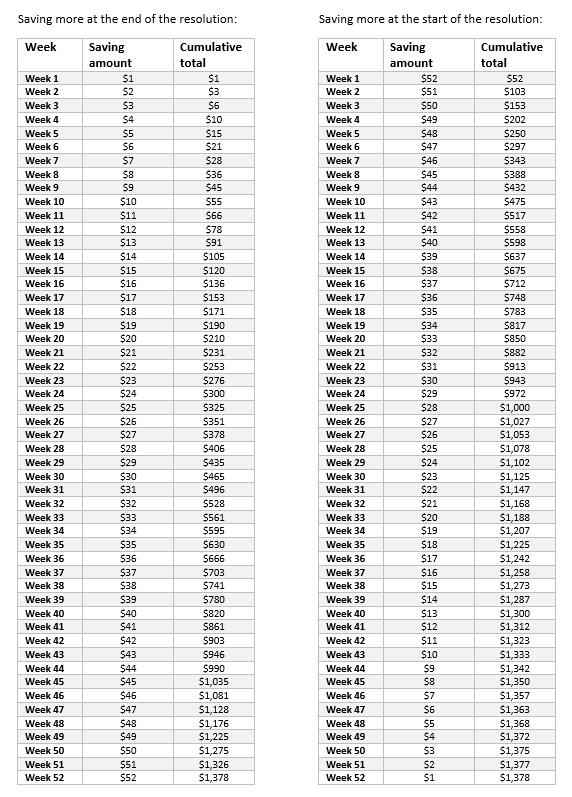
The basis of the challenge is simple: Every week, you add money to your savings account. In Week 1, you save $1. In Week 2, you save $2, and so on, all the way to Week 52, where you will save $52.
At the end of the year using this method, you’ll have saved $1,378.
With this method, the brunt of the savings comes toward the end of the year. And for many, that could be a hefty amount of money to sock away during the holiday season.
If that seems like it’s too daunting of a task, you can reverse the order of savings: i.e. save $52 in Week 1, $51 in Week 2, $50 in Week 3, and so on, all the way to Week 52, where you will save $1.
Here is an example of how the plans will look:
Even if there are some weeks where you can’t meet that week’s savings goal, save what you can that week. There may be some weeks where you can catch up later in the year. Or there may be some weeks earlier in the year where you can save more.
Whatever you do, don’t give up. Staying motivated is the key to sticking with your resolutions, and watching your money grow weekly can help keep you motivated. If you’re ready to get started, click below for more information.
Financially Fit is your home fitness guide for all things financial, provided by RCB Bank. Find money-building tips, insights and inspiration to help you improve your financial well-being at RCBbank.com/GetFit. Opinions expressed above are the personal opinions of the author and meant for generic illustration purposes only. RCB Bank, Member FDIC.
Timing is everything, and that is especially true when purchasing a house. Whether you’re waiting for the right home or applying for a mortgage, there are many time-sensitive processes to follow to ensure you can get the home and the financing you want.
It may seem like there’s a lot of hurry up and wait going on. But because it is likely the biggest purchase you’ll make in your life, there’s a good reason for the wait.
For traditional mortgages, the most noticeable is the three business-day waiting period between receiving your closing disclosure and the consummation date (often known as your closing day). This three business-day rule was introduced in October of 2015, and it applies to both original mortgages and refinancing.
When your three business-day waiting period starts is determined by your consummation day. This three business-day rule may include Saturdays, but it does not count Sundays or holidays.
For instance, if you want to sign on a Friday and a holiday falls on a Thursday, you must receive your closing disclosure on Monday. Because of this, the three-day period is NOT measured by hours.
You can sign the closing disclosure any time before you sign your final documents on your consummation day.
This waiting period gives you time to review all the documents to ensure that the terms you’re agreeing to match the terms outlined at the beginning of the mortgage process when you received your loan estimate (which lenders are required to disclose no later than three days after receiving your completed application).
The closing disclosure will show you the final terms of your mortgage, including your purchase price, interest rate, APR, closing costs, monthly payment, and more. Between the closing disclosure and consummation, if the APR, loan product type or prepayment penalty changes, that would require a revised closing disclosure, which in turn would require a new consummation date. Other changes to terms and costs outside of these (like title fees and insurance), will warrant a corrected closing disclosure, but will not require a new three business-day waiting period.
Basically, the closing disclosure is designed to protect you from bait-and-switch tactics if a lender promised you one set of terms but then presents worse terms just prior to the consummation day.
Opinions expressed above are the personal opinions of RCB Bank personnel and meant for generic illustration purposes only. With approved credit. For specific questions regarding your personal lending needs, please call RCB Bank at 855-BANK-RCB. Some restrictions apply. RCB Bank is an Equal Housing Lender and member FDIC. RCB Bank NMLS #798151.
‘Tis the season for scams.
This Christmas season, be on the lookout for scams and fraud. The Christmas season is the busiest shopping part of the year, and scammers are in full swing waiting to take advantage.
As many retailers begin their Christmas sale specials, scammers are ready with fraudulent websites and social media campaigns, impersonating those retailers. The scammers are hoping to entice you to spend money for products you’ll never receive.
Add in projected shipping delays and supply chain issues, and this Christmas season scammers are projected to be rife. Scammers preying on those will offer products that aren’t available or products that may not be quite what they seem.
Scammers generally won’t have any new tricks during the holiday season, but they will try different spins on scams that have worked in the past. During the Christmas season, scammers thrive as many tend to be more generous and in a giving spirit.
Here are some seasonal scams of which to be aware:
Charity scams
One-third of all charitable giving is done in December, fundraising software company Network for Good reports. That means more sham charities exploiting Americans’ goodwill via fake websites and pushy telemarketers.
Delivery scams
As holiday packages crisscross the country, scammers send out phishing emails disguised as UPS, FedEx or U.S. Postal Service notifications of incoming or missed deliveries. Links lead to phony sign-in pages asking for personal information, or to sites infested with malware.
Travel scams
Nearly 50% of U.S. adults plan to travel during the holidays in 2021, a SurveyMonkey poll found. Spoof booking sites and email offers proliferate, with travel deals that look too good to be true and probably are.
Letter from Santa scams
A custom letter from Ol’ Saint Nick makes a holiday treat for the little ones on your list, and many legitimate businesses offer them. But so do many scammers looking to scavenge personal information about you or, worse, your kids or grandkids, who may not learn until many years later that their identity was stolen and their credit compromised.
Gift card scams
When purchasing gift cards, make sure to purchase from counter attendants or from customer service. Thieves will copy the codes on cards and call after the holidays (when they know they will be activated) and use them before the intended recipient gets a chance to. Grabbing a card from an unattended sales rack increases the chances of having this happen to you.
Being aware of the types of scams that scammers use can help keep you — and your money — safe this Christmas season.
Opinions expressed above are the personal opinions of the author and meant for generic illustration purposes only. RCB Bank, Member FDIC.
The holidays are a time when it’s tempting – and easy – to toss your budget out the window and splurge on your friends and family.
After all, it’s the season of giving. And often, giving the perfect gift is just as fun as receiving a gift.
However, with proper planning, you can stay on budget while spreading Christmas joy and avoiding the stresses that come with searching for that perfect present.
There’s no magic secret to a holiday budget. You’ll have to put the pen to the paper and figure out ahead of time how much you can afford to spend. Then you have to stick to it.
In other words, make a list and check it twice.
Having a budgeted list and sticking to it will help you navigate all the expenses that come with the holidays.
Make a list of everyone you need to buy for and then a price range for each person with gift ideas. If you do this, it will come in handy later.
Let’s say you find a great deal on a gift for one person on your list and it comes in $25 under budget. That can help you later if a gift you found for another person is $20 over budget – you can still purchase that gift, because you were under budget on the first person.
One final tip is to start thinking about next year. Save your receipts. They can come in handy next Christmas when making your budget. You’ll know who all you shopped for and how much you spent on them.
Also, when planning for next year’s Christmas budget, talk to your bank and see if they have options that will help you save throughout the year. They’ll most likely be happy to set up a separate account that you can deposit money into every payday. Then you’ll automatically have your money ready to go!
Make it a challenge to see if you can come in under budget. If that happens, you can reward someone who wasn’t on your list – yourself!
Opinions expressed above are the personal opinions of the author and meant for generic illustration purposes only. RCB Bank, member FDIC.
With the recent news of Social Security benefits increasing by nearly 6% in 2022, now is the time to be on the lookout for Social Security scammers.
Those who receive Social Security benefits don’t have to do anything to receive the increase. The increases will happen automatically.
However, scammers will try to take advantage of those who are unaware that their increase will happen automatically.
These tips from the Social Security Administration (SSA) show you what to look for and how to recognize a Social Security scammer:
Social Security scammers may:
Threaten arrest or legal action against you unless you pay a fine.
Promise to increase your benefits or resolve identity theft if you pay a fee.
Demand payment with retail gift cards, wire transfers, internet currency or by mailing cash.
Pretend they are from Social Security or another government agency. Caller ID, texts or documents sent by email may look official but they are not.
DO NOT BELIEVE THEM!
If you owe money to Social Security, the agency will mail you a letter with payment options and appeal rights. Social Security does not suspend Social Security numbers or demand secrecy from you, ever.
How you can help:
If you receive a questionable call, hang up and report it at ssa.gov.
Do not return unknown calls, email, or texts.
Ask someone you trust for advice before making any large purchase or financial decision.
Do not be embarrassed to report if you shared personal information or suffered a financial loss.
If you think you’ve been a victim of a scammer, call the SSA fraud hotline at 1-800-269-0271.
Opinions expressed above are the personal opinions of the author and meant for generic illustration purposes only. RCB Bank, Member FDIC.
Source:
https://www.ssa.gov/scam/
Spoof websites can lure unsuspecting people into giving away their information without knowing that they’re doing it. A spoof website will try to make itself look almost exactly like the website it is trying to spoof, hoping a person will enter their personal information or username and password.
Once a scammer’s fake, but legitimate-looking website gets indexed by search engines, it will appear in search results based on the search words you type.
Even if you are a seasoned internet user, it is easy to fall prey to the sophisticated techniques that are used in website spoofing. With the wool pulled over your eyes, you could inadvertently give phishers extremely damaging information. The best way to handle spoofed websites is by exercising caution at all times.
Finding your way onto a spoofed website usually happens by using vague or incorrect search engine terms. It also can happen if you type a web address too quickly and accidentally transpose two letters or misspell the web address.
How to spot spoof websites
There are several ways to spot a fake website:
Misspellings and grammar mistakes: While most fraudulent websites try to make it look as close to the actual website they’re trying to spoof as possible, misspellings or improper capitalization of words sometimes creep in. Also look for missing periods or commas
Take a close look at the URL: If the URL isn’t what you expect it to be, it’s probably a spoof website. Close that website as soon as possible.
Blurry logos or images: Because spoof websites don’t have access to original company logos and images, the ones they’ll use are lower resolution and likely will appear to be blurry on the spoof website.
If you see any of these red flags, don’t click on any links.
How to prevent visiting a spoof website
If it is a website you visit often, such as your bank website, bookmarking the website and accessing it directly via the bookmark will prevent you from accidentally typing in the website address incorrectly.
Also, be extra careful when using a search engine. Ensure the words are spelled correctly.
Before clicking on a link, hover over it and read the true website address at the bottom left of the browser. If it isn’t familiar, don’t click on the link.
By taking your time and being careful, you should be able to avoid most problems.
What to do if you suspect a spoof website
If you happen across a spoofed website, you can report the fake website to the federal government here:
Opinions expressed above are the personal opinions of the author and meant for generic illustration purposes only. RCB Bank, Member FDIC.
Starting a savings plan for emergencies may seem like a daunting task. Your goal may seem unreachable or impossible, especially if you’re living paycheck to paycheck.
According to a May 2021 survey, not saving enough for emergencies is Americans’ biggest financial regret.
But why is an emergency savings plan important? Because while you can’t control when something unexpected happens to you, you can control being prepared for the unexpected.
Imagine your air conditioner going out in the July heat on the hottest day of the year. Or, your car breaking down. Unforeseen circumstances can cause problems that can then snowball, if not addressed as soon as possible.
An emergency savings plan creates a financial buffer which helps in times of need and can stave off debt. An emergency savings fund can keep you from needing to take out a payday loan or using high-cost credit cards to cover the cost of the emergency.
According to a July 2021 survey, more than half of Americans have less than three months’ worth of expenses saved in an emergency fund – and 25% have no emergency fund at all – which is up from 21 percent in 2020.
Three months’ worth of savings won’t happen overnight.
So how do you start saving?
If money is tight, start small, with a goal of saving $100. Then $500. Then $1,000. Work your way up to six months’ worth of expenses. It’s not about how much money you make — it is how you manage your money that matters.
Once you have it established, resist the temptation to dip into it.
Have the money direct deposited from your paycheck into a designated emergency fund account – not your checking account – so it’s automatic.
Financially Fit is your home fitness guide for all things financial, provided by RCB Bank. Find money-building tips, insights and inspiration to help you improve your financial well-being at RCBbank.com/GetFit. Opinions expressed above are the personal opinions of the author and meant for generic illustration purposes only. RCB Bank, Member FDIC.
What is auto refinancing?
Auto refinancing is when you replace your current automobile loan with a new loan that has better or different terms. The new loan pays off your original loan and you open a new loan with new paperwork, a new loan rate and new terms and conditions.
When to Refinance Your Car
There are many reasons why someone might need or want to refinance their car:
• Interest rates have gone down since you took out your original loan. If interest rates have dropped, it is worth talking to a lender and seeing what your potential savings could be over the life of the loan.
• You didn’t get the best deal possible when you purchased the car and would like a more favorable loan now. Car dealerships may not offer the best rates possible. If you took out your loan with a dealer and did not negotiate the interest rate, a refinance could save you a lot of money over the life of the loan.
• Your personal finances have changed and you would like a lower monthly payment. While refinancing can reduce your monthly payments, it often means taking a longer loan payoff period. Your car will also depreciate during that time and you may pay more in interest over the life of the loan. Term restrictions may also apply depending on the year of the vehicle.
• Your credit has improved since you received your original loan. If you previously had bad credit or no credit, checking to see if you can get a better deal a few years down the road is a good idea. You may receive better offers and save money over the life of the loan with a lower interest rate.
How to Refinance Your Car
Before you decide to refinance, talk to a few lenders to see what rates they offer and whether it will save you money over the life of the loan. Find out if there is a prepayment penalty, or fee for paying off your other loan early, and what others fees you may be responsible for when you refinance. You will also want to make sure your car’s value is more than the loan amount left, or it could be hard to get a new loan. Some lenders may have restrictions about the age of the car they will refinance.
Once you have determined if refinancing is a good option, prepare your documentation. You will likely need a number of documents on hand to apply for a new loan.
• Proof of income
• Evidence of auto insurance.
• Information on your current loan.
• Information about the car, including the make, model, mileage, year and vehicle identification number, or VIN.
• Your driver’s license.
After you have gathered your documentation, shop around. Look for loan promotions in your area and get prequalified with a few different lenders. Some lenders also offer a discount if you use an automatic payment option, so don’t forget to ask.
GAP Insurance
GAP, also known as Guaranteed Asset Protection, provides the consumer with protection in the event of a total loss of the covered car due to vehicle theft or an accident. If a total loss occurs, you file a claim and GAP will pay off the residual loan balance that the primary claim fails to pay. Given the ever-increasing costs of a complete vehicle restoration after an accident, GAP protection may be needed more now than ever before.
When to Get Car GAP Insurance
As a general rule, if you have less than 20% equity in on the car when you open the loan, GAP coverage should be considered. Conversely, if you enter the loan with more than 20% equity in the car, GAP coverage becomes less beneficial and effective. Also, the longer the loan period, the more helpful GAP coverage becomes.
Our lenders are happy to answer your questions, even if you are not an RCB Bank customer. Connect with a lender in your area.
Financing available with approved credit. Other qualifications, restrictions, and conditions may apply.
Mortgage Refinancing Basics
What is refinancing?
A mortgage refinance is when you replace your current mortgage with a new mortgage. There are many reasons why homeowners may want or need to refinance:
To shorten the terms of their current mortgage.
To get a lower interest rate than their current mortgage.
To use the equity of the home to finance a large purchase, pay for an emergency or consolidate debt.
To convert your loan from an adjustable interest rate to a fixed interest rate.
To get the PMI (primary mortgage insurance) requirement removed. Many FHA loans require mortgage insurance for the life of the loan. A conventional loan will generally not require mortgage insurance if you have paid your loan balance down to 78% or less of the appraised value.
When to Refinance
In order to know if refinancing is a good option for you, you need to understand your long-term goals and your current financial situation. If you are refinancing to take advantage of lower interest rates, there are mortgage calculators that give you an estimate of how much it will cost to refinance and how much you can save over the life of the loan.
You also want to consider the break-even point, or how long it takes to earn back the money you spent to refinance. For instance, if it will take seven years to earn back the money you spent to refinance and you plan on moving in three years, it is probably a bad idea to refinance your loan.
Your personal finances can also determine if it is a good idea to refinance. If you need lower monthly payments because money is tight, refinancing might be a good option to relieve the monthly stress of the payment.
How to Refinance Your Home
In order to refinance your home, you will need to get approved for a loan the same way you did for the original financing. The first thing to do is have your documentation ready. This can include pay stubs, bank statements, a credit check, tax documentation and anything else your lender requests. It is also important to know that a strong credit score will have a positive impact on your refinancing terms. You may want to wait a few months to improve your credit score before starting the process.
Once your documentation is in order and your credit score is in a good place, you should then apply for a refinance with several different lenders. Apply at three or four places and do so in a short-time period so it reduces the impact on your credit score.
After you receive the loan estimate from different lenders, compare those documents and determine how much you will likely pay in closing costs. Closely compare the lenders’ fees, which could include the Origination Fee, Discounts Fee, Underwriting, Processing and Tax service Fee. Some third party fees, such as appraisers and title company fees, will likely be the same no matter what lender you choose. Choose the lender that works best for you and try to get your rate locked in as soon as possible. Then you will work with your lender to close on the loan in the exact same way you closed on your mortgage the first time.
No matter what you decide, do your research and ensure it makes financial sense to refinance before beginning the process. Lenders at RCB Bank are happy to help answer questions even if you are not a customer. Give us a call or visit our online Mortgage Center.
Opinions expressed above are the personal opinions of RCB Bank personnel and meant for generic illustration purposes only. For specific questions regarding your personal lending needs, please call RCB Bank at 855-BANK-RCB. With approved credit. Some restrictions apply. RCB Bank is an Equal Housing Lender and member FDIC. RCB Bank NMLS #798151.
Malware, otherwise known as malicious software, is a type of fraud that uses viruses, spyware, or other software to intentionally damage a computer, server, device or computer network. Criminals use malware to steal personal information, commit fraud, send spam or monitor and control online activity.
There are many different types of malware, including spyware, viruses, worms, adware and ransomware. Your computer may contain malware if you are experiencing one or more of the following problems:
• Your computer slows down, crashes or displays constant error messages.
• You cannot shut down or restart your computer.
• Unexpected messages and ads frequently pop-up on screen.
• You lose access to computer files.
• Settings on your browser change, such as the toolbar or home page.
Ransomware
Ransomware is a type of malware designed to hold data hostage. Ransomware encrypts or conceals access to your files in attempt to get you to pay a ransom to regain access. This is a growing threat for both individuals and businesses alike. The most common targets for ransomware attacks are small to medium-sized businesses, school districts, municipalities, health¬care institutions and financial institutions.
How to Prevent Malware
Most common malware attacks occur on the internet and email. To prevent malware, use up-to-date security software and firewalls. Do not change the security settings on your browser and pay attention if you receive a security notification from your browser. More tips to protect yourself from malware:
• Use strong passwords and multi-factor authentication.
• Do not download any unknown software or click on links in email, text messages or social media.
• Do not click on pop-up ads or banners that show up on your computer.
• Back up your data regularly.
• In emails, you should never click on a link you do not know or recognize.
Report a Scam
If you think your computer has malware, report it to the Federal Trade Commission here. You can also file an incident with the Cybersecurity & Infrastructure Security Agency here. If your personal information is compromised or fraud has occurred, call your bank immediately and call a credit reporting agency such as Equifax to place a fraud alert on your account. You can also contact your state Attorney General to report fraud.
Types of Construction Loans
A variety of constructions loans are available to homebuyers. It all depends on your specific situation. If you want to shop around and potentially use more than one lender, then getting two separate loans (one for the construction and then a second to pay off the construction loan and put the debt into monthly payments) may be the best choice. If you prefer to work with one bank and one lender, a construction-to-permanent loan may be the best finance solution. The important part is that you talk with a trusted banking professional before making any decisions.
Construction Only Loan
In this scenario, the borrower actually gets two loans. The first loan finances the construction of the home and the second loan refinances the construction into a long-term mortgage. This type of loan allows the homeowner to work with different lenders for the construction and permanent financing if they would like. The upside of doing this this loan is that you may have more flexibility if there are cost overruns and you can typically draw out money more often. A potential downside is that you typically cannot lock-in your interest rate or obtain full underwriting approval on your permanent loan until 90 days or less before home is complete.
Construction-to-Permanent Loan
With a construction-to-permanent, or “one time close,” loan you finance the construction of your home and the permanent financing with a single loan. In this type of a transaction the lender releases the money to the builder, contractor or other authorized suppliers as the phases of the construction are complete. The upside of this type of loan is that you know the details of your permanent financing up front. The downside is that these loans may be more limited in the number of times you can draw money to pay builders and contracts. It can also be more difficult to change your loan amount due to cost overruns.
Renovation Loan
If you see the home of your dreams, but it is a fixer-upper, a home renovation loan may be the right solution. A home renovation loan is based on the value of your home after the renovation is complete. This means you are borrowing against the future equity of your home and not just its current value. This may be a good option if the renovations are likely to increase the value of your home and/or reduce the long-term costs of the home.
Home Equity Line of Credit (HELOC)
A HELOC is a line of credit secured by your home based on the current equity of your home. A HELOC may have lower closing costs than a traditional construction loan. Another upside is that most banks only charge interest on what you draw, or use, from the HELOC and not from the total amount approved. A potential downside is that rates for a HELOC are often variable and can increase throughout the life of the loan.
Lenders at RCB Bank are happy to help answer questions even if you are not a customer. Give us a call or visit our online Mortgage Center.
Opinions expressed above are the personal opinions of RCB Bank personnel and meant for generic illustration purposes only. For specific questions regarding your personal lending needs, please call RCB Bank at 855-BANK-RCB. With approved credit. Some restrictions apply. RCB Bank is an Equal Housing Lender and member FDIC. RCB Bank NMLS #798151.
It starts with a morning coffee or a quick lunch out. Maybe you want the newest tech gadget or video game. Before you know it, you have the item, but you also have more financial stress.
This is common scenario for many Americans. In fact, 71% of Americans report feeling stressed about money, according to a recent survey done by American Psychological Association. However, these simple budget strategies may help relieve stress and improve your finances.
Step 1: Know your Expenses
Before you can create a budget plan, evaluate your personal money habits. For a few weeks, use text banking, online banking or your debit card records to track your spending. Once you know what you are spending money on, determine if those things are wants or needs.
A simple way to track these personal expenses is to take a piece of paper and write “wants” on one side and “needs” on the other. Wants are things you enjoy, but don’t necessarily need. Needs are essential items you need to live such as your rent or mortgage payment, food, water and clothing. Calculate how much you are spending in each column, then look for places to cut costs.
Step 2: Create a Budget Plan
After you know all your expenses, evaluate your monthly bills and see where you can cut costs. One simple budget idea is to reduce the amount you eat out or order take-out. Instead, create a grocery list, plan your meals and cook at home. You may be surprised at how much money you save. To pinch a few more pennies, look for coupons on items you regularly purchase and buy off-brand items.
Another good way to save money is to change your phone plan or provider. If you signed up for 10GB of data per month and your phone company shows you only use half of that, change your plan and reduce your bill. You can also research deals other carriers offer a few times a year. Even if you only save $20 or $30 each month, those savings add up.
Another way to reduce financial stress is to budget the amount of money you spend on streaming or cable services. If you can reduce one or more streaming service every month, you can save a hundred dollars or more every year. You can also call your cable company and talk about ways to reduce your monthly bill.
Step 3: Make Saving Money a Habit
Once you know how much money you are spending and have created a budget, start saving. One way to save is to call your bank and set up automatic savings. In this case, the bank can schedule a recurring time to move your money to a savings account before you have a chance to spend it. Even if you only contribute $50 or $100 each month, these savings allow you to prepare for unexpected costs such as medical bills, car or home repairs.
Once you have started saving and have an emergency fund in place, you should consider long-term savings goals such as education funds for your kids or retirement accounts for yourself. It is best to meet with a wealth advisor to discuss these long-term investment options and how to plan for the future.
Just remember, it all starts with one small thing. Whether you brew your own coffee at home, bring your lunch a few days a week or cut one streaming service, every little bit helps.
Opinions expressed above are the personal opinions of the author and meant for generic illustration purposes only. RCB Bank, member FDIC.
While most of us know saving money is a good idea, we often struggle to save for the future. Saving is not a one size fits all solution, but building a savings plan for your future is an important step to becoming financially independent. Talk with a wealth advisor about your personal goals. Your future self will thank you.
Build an Emergency Fund
Set a reasonable goal. Start by trying to save a small amount, such as $1,000. Don’t feel pressure about how much you are saving, just save something.
Take the next step: Track your spending and develop a budget. Do everything you can to stay within your budget. Little things will help you succeed, e.g., set up automatic savings with your bank, create a grocery list (and stick to it), cut coupons and save change.
Save for Education
Consider education investment programs. A traditional savings plan is good, but you also may want to consider an investment account.
Take the next step: Look up your state’s options for 529 plans or speak with a wealth advisor on interest-earning, tax-advantage plans. Some education plans allow you to use earnings on tuition and fees (including K-12 public and private), books, computer equipment and room and board.
Retirement Planning
Save today for your future self. There are four primary ways you can fund your retirement: personal savings (e.g., IRAs and investment accounts); Employer retirement plans; Social Security benefits and retirement income (rental property, part-time job).
Take the next step: Talk with a wealth advisor who can help you build a retirement savings plan and income strategy to maximize your savings.
Opinions expressed above are the personal opinions of the author and meant for generic illustration purposes only. Investment products are not insured by the FDIC. Not a deposit or other obligation of, or guaranteed by the depository institution. Subject to investment risks, including possible loss of the principal amount invested. Ask for details.
Do you want to renovate a home after buying? Are you considering building a new home? In these situations and many others, you will need a construction loan before you start a traditional mortgage. Depending on your situation, different loans are required.
Construction to permanent
With a construction to permanent loan the lender releases money to the builder as phases of the construction are completed.
Upside: Once the build is complete, the loan converts to a standard 15 or 30-year mortgage.
Downside: You have to lock in the interest rate at the beginning of the process. It can take a year or more to build a home and interest rates could be lower by the time you actually move in.
Construction only
Another way to finance the construction of your home is with a stand-alone construction loan. With this loan type, the homeowner take two loans. The first loan finances the construction of the home and the second refinances the construction loan into a long-term mortgage.
Downside: Since you obtain two separate loans, you pay two sets of closing costs and go through multiple loans applications and closings.
Upside: If you want to shop around for mortgage options instead of being locked into one lender’s options, you can secure a lower interest rate.
Renovation construction loans
These loans are available to people who want to do a renovation, but do not have the money to finance it themselves. You have many options to pay for home improvements, including personal loans, lines of credit or government insured loans.
Upside: Renovations can increase the value of your home or reduce your costs in the long-term. Bathrooms, new insulation, kitchens and finishing basements all add value to a home.
Downside: The improvement in home value may not justify the cost of renovations. There is also a chance renovations will cost more or take longer than you expected.
We are to here to help, even if you are not an RCB Bank customer. Connect with a local RCB Bank lender to get answers to your lending questions.
Opinions expressed above are the personal opinions of the author and meant for generic illustration purposes only. With approved credit. Some restrictions apply. RCB Bank is an Equal Housing Lender and member FDIC. RCB Bank NMLS #798151.
Reduce Expenses
It’s a good habit to annually review your monthly expenses, looking for areas where you can cut costs. Start by discontinuing unused memberships/subscriptions. Call your cable, phone and insurance companies and ask for options to reduce your bill. Compare prices of other companies or consider alternatives like pre-paid phones or streaming services. Reduce utility expenses by adjusting your thermostat a few degrees. Unplug electrical items when not in use and reduce the number of days you water the lawn.
Reuse Stuff
Use less. Save more. An easy start is to ditch disposable items. Clean with rags rather than paper towels or cleaning wipes. Use reusable water bottles and dishes instead of buying bottled water and paper plates. Look for creative ways to repurpose common household items. Save glass jelly jars or clear plastic containers to organize your kitchen, office or craft room items. Cut up your old t-shirts for cleaning rags. Grab those Easter eggs and use them as handy snack containers. Find more money-saving ideas online.
Rethink Spending
Rethink your purchase decisions. Start by making a list and sticking to it. Consider paying with cash. And bring only the cash you need, so you’re not tempted to splurge. Before grocery shopping, plan out your meals, check your cabinets for what you already have and buy only what you need. Use coupons and avoid impulse purchases. Choose off-brand items. They’re made the same but without an expensive label.
Opinions expressed above are the personal opinions of the author and meant for generic illustration purposes only.
No matter what stage of life you are in, your current and future financial well-being should ALWAYS be in your plans. Taking full advantage of your workplace retirement savings options plus utilizing the help of a professional wealth advisor can help you build enough resources to enjoy the retirement lifestyle you want.
Baby Boomers: Born 1946-1964
You are at or nearing retirement age. Boomers are breaking boundaries and re-defining retirement for the generations to follow.
Have you accumulated enough assets to comfortably supplement Social Security?
Do you know how long those assets might last?
Are you confident you are managing your investments to preserve what you’ve built?
Generation X: Born 1965-1980
You have limited time left to accumulate sufficient assets for retirement. The temptation to raid your retirement savings to help fund your children’s college or to provide care for aging parents may be very real for you.
Do you understand the costs of this decision?
Do you need help prioritizing your financial obligations?
Are you saving enough now to generate the income you will need for 20-35 years of life in retirement?
Generation Y: Born 1981-1996
Retirement seems far away and may not be on your radar. Statistically, your generation saves better than the one before. But, your mobility often causes small repeated cash-outs from retirement accounts as you move from job to job, leaving little savings as the years go by.
Time is on your side if you take advantage of it now.
Aim to save a minimum of 10% (including your employer’s contribution, if available, and any IRA’s or other plans).
Provide for your future self by including retirement savings in your current budget.
Generation Z: Born 1997-Present
You may not have the obligations of a mortgage or children. This puts you in a prime position to build your retirement nest egg.
The sooner you start saving, the longer your money has a chance to grow with compounding interest.
Aim to put at least 5% away for retirement.
Don’t be tempted to cash out your retirement account if you switch jobs.
Make retirement savings a necessary expense in your budget.
Investment products not insured by the FDIC. Not a deposit or other obligation of, or guaranteed by the depository institution. Subject to investment risks, including possible loss of principal amount invested. The information provided is for educational purposes only and does not constitute tax, investment or legal advice. Consult a professional wealth advisor to discuss your individual retirement savings needs.
A mortgage is one of the most expensive and long-term commitments you will make in your life. So how can you both save money and take years off your loan? It’s actually pretty simple. If you pay just a little extra on your mortgage each month or year, you will owe significantly less over the life of the loan.
Although most borrowers know their home is a valuable asset, they often don’t consider how much interest adds to their overall cost. Your mortgage is amortized, meaning you pay regular installments on principal and interest over the specified period of time. Every time you pay your mortgage, interest costs decrease and the principal increases. If you pay nothing extra on the mortgage, the total amount you owe over the life of the loan will not change. However, pay a little extra and you can take years off your loan and save thousands of dollars in interest.
Let’s look at this closer. If you get a 30-year loan for $250,000 and it accrues 4% interest per year, you will end up paying $179,674 in interest over the life of the loan. This is a big number, but one you can reduce by budgeting some extra money for your mortgage.
Using the example I’ve just described, the monthly mortgage payment is $1193.54 per month. If you can make one extra mortgage payment per year, you can save over $28,000 in interest over the life of the loan! Make it a Christmas present and pay a little at a time or make one lump payment at the end of each year. Paying just a little extra on your mortgage is the gift that keeps giving.
The more knowledge you have about the mortgage process, available loan options and your individual qualifications, the more satisfying your homebuying experience will be. Connect with a local RCB Bank lender to get answers to your lending questions. Give us a call or visit our online Mortgage Center.
Opinions expressed above are the personal opinions of the author and meant for generic illustration purposes only. The monthly payment calculation expressed above is not for any specific loan type and is meant for generic illustration purposes only. For specific questions regarding your personal lending needs, please call RCB Bank at 855-BANK-RCB. With approved credit. Some restrictions apply. Equal Housing Lender, Member FDIC. RCB Bank NMLS #798151.
If you are preparing to buy or refinance a home, take a look at your VA Loan option, which offers lower out-of-pocket financing than traditional lending options. Here are five benefits of VA Loans.
No. 1. 100% Financing
The U.S. Department of Veteran Affairs (VA) guarantees this loan, allowing you to finance the entire purchase price of the home. Nearly all conventional and FHA loans require the loan-to-value to be below 100%.
No. 2. No Monthly Mortgage Insurance Costs
Most loans with less than a 20% down payment require you to pay for a mortgage insurance premium (for FHA loans) and private mortgage insurance, commonly referred to as PMI, for conventional loans.
While there is no monthly mortgage insurance, there is a one-time funding fee, which ranges from 1.5% – 3.3%, based on your eligibility and down payment. You may also be exempt from the funding fee if you were awarded a service-related disability.
You are also able to roll your funding fee into the loan to help keep your out-of-pocket expenses lower at closing.
No. 3. More Flexible Underwriting Standards
A VA Loan is the only loan that does not require student loans deferred over one year to be included in the debt–to-income ratio, which is used by lenders to determine how much you can afford to borrow. Also, a VA loan allows for higher debt ratios than other loans like FHA, conventional and rural development.
No. 4. You Can Have Two VA Home Loans at a Time
VA does allow you to purchase another home if you are choosing to move prior to selling your current VA-financed home. It depends on how much entitlement you have left from the previous purchase and the loan limits in the area where you are buying your new home. Your mortgage lender can help you calculate your entitlement and qualification.
No. 5. VA Jumbo Option Available
In most counties today, the maximum loan limit for conforming conventional and VA loans is $484,350. However, there are certain counties where the VA maximum loan limit exceeds $484,350; these loans are known was VA Jumbo loans. These amounts are current as of the time of writing this article. Most Jumbo loans require 20% down payment; however, VA loans do not. Depending on your eligibility, you may be able to pay a 10% or less down payment.
You can learn more about eligibility requirements at www.benefits.va.gov. Search VA home loans.
When it comes to obtaining a VA Loan, you want to work with a qualified VA mortgage lender. RCB Bank is proud to offer a VA loan benefit to our active duty service members and veterans. We can help you determine your eligibility and what you qualify for. Plus, once you start the loan process, we’re here to walk you through start to finish.
Opinions expressed above are the personal opinions of the author and meant for generic illustration purposes only. For specific questions regarding your personal lending needs, please call RCB Bank at 855-BANK-RCB. With approved credit. Some restrictions apply. Equal Housing Lender, Member FDIC. RCB Bank NMLS #798151.
There is a lot of incorrect information out there that may persuade you not to pursue getting a home. Before you run in fear, talk to a lender first about your concerns, so we can help you know what is truth or myth.
Myth #1:You have to have a 20% down payment in order to get a mortgage – WRONG.
There are many down payment options. For instance, if you are a veteran, or buying in a rural location, you could potentially get into your new home with little to no down payment.
Several first-time homebuyer loan options start with a 3% down payment, and Federal Housing Administration (FHA) offers financing options starting with a 3.5% down payment.
With all of these down payment options, homeownership may be more BOOlievable than you think.
Myth #2: Being Pre-Qualified is the same as being Pre-Approved – WRONG.
Pre-qualification is based on un-verified information. This is an initial look at your application to make sure there are no major red flags that may prevent you from getting a mortgage. For example, a pre-qualification may use an estimate of your credit score and compare your income with your debts to see if you can support a mortgage payment. The pre-qualification process is quick and is based on information you provide to your lender. A pre-approval is a more extensive process where the lender uses verified information (e.g., your credit report and pay stubs) to determine which mortgage you actually qualify for.
Without a pre-qualification or pre-approval, home shopping may become a frightfully batty experience.
Myth #3: Shopping around for lenders will hurt your credit – WRONG.
Multiple inquiries can hurt your credit, but FICO allows for rate shopping by grouping all similar inquiries made within a 30-day timeframe as one hard-hit. This allows you to shop around as long as it is within 30 calendar days.
When shopping lenders, be sure to ask what fees they charge, what the interest rate and annual percentage rate (APR) are, and if you aren’t putting 20% down, what is the cost for private mortgage insurance (PMI).
Don’t be spooked by misinformation about mortgages. Talk to a lender and get the truth. I’m here to help you have a FANGtastic homebuying experience, even if you are not an RCB Bank customer. Connect with a local RCB Bank lender to get answers to your lending questions. Give us a call or visit our online Mortgage Center.
Opinions expressed above are the personal opinions of RCB Bank personnel and meant for generic illustration purposes only. With approved credit. For specific questions regarding your personal lending needs, please call RCB Bank at 855-BANK-RCB. Some restrictions apply. RCB Bank is an Equal Housing Lender and member FDIC. RCB Bank NMLS #798151.
New cars can quickly depreciate in value causing your auto insurance to pay less than what you owe on your car loan. What happens when an accident totals your car? Who pays the difference between the insurance settlement and your outstanding loan balance? You do. Or, maybe not.
Get$Fit Tip: Protect your assets.
It may be worth buying Guaranteed Asset Protection (GAP) coverage to help you avoid the risk of negative equity and having to continue making principal payments after a total loss. Depending on your loan term, GAP adds on average an estimated $7-$111 to your monthly loan payment, but it potentially could save you thousands of dollars in the event of loss.
When GAP may benefit you:
• You make a small or no down payment on a new car
• You agree to a loan term longer than 48 months
Talk to a lender for details to see if GAP is right for you.
Our lenders are happy to answer your questions, even if you are not an RCB Bank customer. Connect with a lender in your area.
Invest in yourself. RCBbank.com/GetFit
1GAP insurance costs varies between lenders and loan terms. See your lender for specific questions regarding your personal loan qualifications and overall costs. 2GAP Insurance covers the residual value of the loan as of the date of loss. Ancillary products can be purchased at an additional cost, which vary based on loan terms. Qualifications and restrictions apply. Above example is for generic illustration purposes only, based on 700 credit score. Does not factor in down payments, additional fees or other costs. Subject to credit approval. Rates are accurate as of June 15, 2018, and subject to change without notice. Opinions expressed above are the personal opinions of the author and meant for generic illustration purposes only. Member FDIC and Equal Housing Lender, RCB Bank NMLS #798151.
Private Mortgage Insurance, or PMI, is a term that often swirls around the world of homebuying, leaving many prospective homeowners confused about its purpose and implications. Understanding PMI is crucial for anyone looking to purchase a home, as it can affect the overall cost of homeownership.
PMI is typically required by lenders when a homebuyer makes a down payment of less than 20% of the home’s purchase price. It serves as a protection for the lender in case the borrower defaults on their loan. While PMI benefits the lender, it allows buyers to qualify for a mortgage with a lower down payment, making homeownership more accessible to many.
There are a few ways that you can pay the PMI: monthly payment or single upfront payment. The most common method is a monthly premium. In this case, your lender automatically adds PMI to your monthly mortgage payment. This reduces the large upfront payment though monthly payments will be higher. Once the loan-to-value ratio reaches 80%, homeowners can request cancellation of PMI.
If the monthly premium is not an option then there is the upfront premium where the costs are paid in full. In this case, your lender arranges for you to pay PMI when you close on the loan. While it’s an additional closing cost, your monthly mortgage payment will be lower.
There are several ways to avoid or eliminate PMI altogether. Firstly, saving up for a larger down payment can help buyers avoid PMI requirements entirely. Additionally, some lenders offer piggyback loans or lender-paid PMI options, although these may come with their own set of terms and conditions. Check with your potential lender for more information before proceeding.
Understanding the costs and implications of PMI is crucial for prospective homeowners. While it can increase monthly payments, PMI enables many individuals and families to achieve the dream of homeownership sooner rather than later. However, it’s essential to weigh the long-term costs and benefits and explore all available options before committing to a mortgage with PMI.
In conclusion, PMI plays a significant role in the homebuying process, particularly for those with smaller down payments. By demystifying PMI and understanding its implications, prospective homeowners can make informed decisions when navigating the complexities of mortgage financing.
You can contact one of our Mortgage Representatives now to assist you today with lending and PMI!
Opinions expressed above are the personal opinions of the author and meant for generic illustration purposes only. With approved credit. For specific questions regarding your personal lending needs, please call RCB Bank at 855-BANK-RCB. Some restrictions apply. RCB Bank is an Equal Housing Lender NMLS #798151 and Member FDIC.
Making a plan to pay off credit card debt is essential for anyone facing financial strain due to outstanding balances. The first step is to gather all credit card statements to understand the full scope of the debt. This includes noting the outstanding balances, interest rates and minimum monthly payments for each card.
Next, prioritize the debts based on interest rates. In general, the higher-interest cards should be paid off first to minimize the amount of interest accrued over time. While paying the minimum on all cards, allocate extra funds towards the highest interest debt. This approach, known as the avalanche method, can save money in the long run.
Alternatively, some may prefer the snowball method, which involves paying off the smallest debts first to gain momentum and motivation. Regardless of the method chosen, consistency is key. Stick to the plan by setting realistic monthly payments and avoiding accumulating additional debt. Utilize any extra income, windfalls or bonuses to accelerate debt repayment.
Creating a budget can help identify areas where expenses can be reduced to free up more funds for debt repayment. Cut back on unnecessary expenses and allocate the savings towards paying off credit card debt.
Finally, monitor progress regularly and adjust the plan as needed. Celebrate milestones along the way to stay motivated and committed to becoming debt-free. By making a plan and sticking to it, individuals can take control of their finances and achieve financial freedom. With discipline and determination, paying off credit card debt is achievable, leading to a more secure financial future.
The opinions expressed above are the personal opinions of the author and meant for generic illustration purposes only. For specific questions regarding your personal lending needs, please call RCB Bank at 855-BANK-RCB. RCB Bank is a member FDIC.
Broken Arrow, OK – Rene Hill is a seasoned professional with a rich history in the banking industry. Starting as a Teller at First National Bank Broken Arrow, her journey led her to RCB Bank in 2001, where she’s been instrumental in customer service and team leadership.
Her professional journey is a testament to her dedication and drive for growth within the banking sector. Her commitment to staff and customers aligns with her goal of providing stable and reliable service. “I’m dedicated to building a team of like-minded CSRs & tellers, fostering loyalty to RCB Bank and its valued customers,” says Rene.
Known for her adept problem-solving skills and efficient work ethic, Rene is highly regarded by her customers for her professionalism and extensive knowledge of financial services.
Outside work, Rene finds balance through hobbies like traveling, reading, gardening and church activities, reflecting her dedication to personal well-being and community involvement. “Good morals, integrity and gratefulness guide my decisions,” she affirms, emphasizing the importance of values in both personal and professional realms.
Looking ahead, Rene remains steadfast in her commitment to ensuring stability with customers and employees by adapting and evolving alongside the ever-changing financial landscape, maintaining RCB Bank’s reputation for reliability and innovation.
With her leadership style characterized by a democratic approach and a focus on mentorship, Rene’s influence extends far beyond her immediate team. Her guiding principles of “take action” and “be responsive” serve as pillars of success, driving excellence in every aspect of her professional journey.
RCB Bank is a community bank with locations across Oklahoma and Kansas. Founded in 1936, RCB Bank is committed to serving its communities with conservative banking practices and progressive banking products. Learn more at RCBbank.bank or give us a call at 855.226.5722. Member FDIC, Equal Housing Lender, NMLS #798151.
Lawrence, KS – Kent Fisher, a Mortgage Loan Originator at RCB Bank, brings over 25 years of financial services experience to his role. With a diverse background spanning across sales, finance and financial planning, Kent is well-equipped to assist clients in navigating the complexities of the mortgage market.
Starting his career in the automotive industry, Kent honed his skills in sales and finance before transitioning to financial planning, where he earned Series 7 & Series 63 securities licenses. This foundational knowledge laid the groundwork for his eventual transition into lending and financial analysis roles.
Joining RCB Bank in February 2024, Kent was attracted by the organization’s positive culture and the leadership demonstrated at the local branch. He saw an opportunity that could leverage his expertise to serve the Lawrence community effectively in the banking industry.
As a Mortgage Loan Originator, Kent prioritizes client satisfaction, providing personalized guidance and sound financial advice. His proficiency in credit analysis enables him to tailor loan solutions to meet clients’ needs, while his networking abilities foster strong relationships with local realtors.
“In work and life, integrity guides every decision. Doing what’s right, even when no one is watching, that’s the cornerstone of success.” – Kent Fisher
Kent’s commitment to professional integrity is evident in his approach to client service, characterized by sincerity and attentiveness. Beyond his professional endeavors, Kent is actively involved in community service, volunteering with organizations such as the Lawrence Board of Realtors and the First United Methodist Church. He also supports grassroots initiatives like the Ballard Center, which provides essential services to individuals and families in need.
Motivated by results, Kent aims to solidify RCB Bank’s reputation as a leading mortgage lender in the Lawrence market while upholding his values of integrity and client advocacy.
Kent Fisher
Mortgage Loan Originator
3300 W. 6th St. Lawrence, KS 66049
RCB Bank is a community bank with locations across Kansas and Oklahoma. Founded in 1936, RCB Bank is committed to serving its communities with conservative banking practices and progressive banking products. Learn more at RCBbank.bank or give us a call at 855.226.5722. Member FDIC, Equal Housing Lender, NMLS #798151.
There has been a drastic increase in mobile device fraud. Do NOT click on anything that you’re not expecting to receive.Learn about the hazards of falling victim to cell phone fraud and how to mitigate the risks below.
How mobile device fraud works: The fraudster will send a text message directing you to “click here.” This action may or may not download malware to your cellular device. The link can also forward your phone and its information. The information the fraudster gains could allow them to imitate you by accessing your data.
How can I stop it? If your cell phone has been compromised or stops working, please visit your cell phone provider. Explain that you may be experiencing a SIM swap and need your SIM turned off immediately and replaced.
How to minimize phone fraud risks: Do NOT click on any links that you are not expecting to receive. Questions you need to always ask yourself about links in emails or texts:
Were you expecting this message and link?
Is it from someone you trust?
Does the email/phone number match the contact information that you have for that person?
If any of your answers to the above questions are no, then you need to contact that person using a separate method from how you received the notification to verify whether the message is legitimate.
By following these simple steps, you may navigate safely through texts and emails while protecting your personal information from potential risks. In case you have already fallen victim to a scam, steps can be taken to mitigate further harm. Victims should contact the FBI through ic3.gov to report identity theft, reach out to their bank’s fraud department and remain vigilant against future scam attempts. You can call RCB Bank Fraud at 855-226-5722 or visit our Security Center.
Opinions expressed above are the personal opinions of the author and meant for generic illustration purposes only. RCB Bank, Member FDIC.
“Trigger Lead” is a term used in the mortgage industry to refer to a type of lead generated when a consumer’s credit report is accessed by a lender or creditor for the purpose of extending credit. These leads are often sold to other lenders or service providers who then use the information to reach out to the consumer with offers for credit or other related products.
When a consumer applies for a mortgage or other type of loan, their credit report may be accessed multiple times by different lenders during the application process. Each time a lender pulls the consumer’s credit report, it generates a trigger lead, indicating to other lenders that the consumer is actively seeking credit.
This can result in the consumer receiving numerous unsolicited calls or offers from lenders trying to win their business. While trigger leads can be beneficial for lenders looking to attract new customers, they can be overwhelming and intrusive for consumers who may already be dealing with the stress of the loan application process.
To opt out of trigger leads, consumers can take steps to limit the number of calls they receive. One option is to register for National Do Not Call Registry. A second option is to opt out of prescreened mail offers by visiting OptOutPrescreen.com or calling 1-888-5-OPT-OUT (1-888-567-8688).
Additionally, there are efforts underway to address the issue of trigger leads at the legislative level. A bill currently under construction in the House aims to regulate the use of trigger leads and provide consumers with more control over who can access their credit information. If passed, this legislation could help protect consumers from unwanted solicitations and give them more control over their personal financial information.
Contact one of our Mortgage Loan Originator now to assist you today!
Opinions expressed above are the personal opinions of the author and meant for generic illustration purposes only. With approved credit. For specific questions regarding your personal lending needs, please call RCB Bank at 855-BANK-RCB. Some restrictions apply. RCB Bank is an Equal Housing Lender, NMLS #798151 and Member FDIC.
Trigger leads –. – No other lead offers so much for so little as trigger leads. (2024, February 26). https://triggerleads.com/
Wichita, KS – RCB Bank proudly welcomes Victoria Kloepper as a Loan Officer to our Wichita East location at 8411 E. 21st St N. in Wichita, Kansas.
Victoria began her career as a part-time teller during college and brings over 15 years of banking experience to her new role. During her time in college she fell in love with the business side of banking and decided then she knew what her career path was going to be.
“I joined RCB Bank because of the exciting opportunity to work alongside a dynamic team,” states Victoria. “I’m eager to utilize my expertise in both consumer and commercial lending to better serve my customers.”
With her passion for lending services, Victoria continues her professional growth within the banking industry by staying updated on trends, attending conferences and networking. This commitment is evident to her approach in building lasting customer relationships. “I focus on understanding each client’s unique needs and providing tailored solutions,” explains Victoria.
When it comes to her ability to work as a team, Victoria prioritizes taking care of her teammates by celebrating team achievements and milestones. She believes that is integral to a team’s success.
While not at work Victoria enjoys spending time outdoors with her three-year-old son and engaging in activities like running and clay shooting. When the weather does not permit outdoor activity, she enjoys cooking, art and dining at new restaurants. She values work-life balance and prioritizes family, health and personal growth.
Looking to the future, Victoria aims to utilize her resources in establishing a robust network of customers and continue her professional development at RCB Bank.
RCB Bank is a community bank with locations across Kansas and Oklahoma. Founded in 1936, RCB Bank is committed to serving its communities with conservative banking practices and progressive banking products. Learn more at RCBbank.bank or give us a call at 855.226.5722. Member FDIC, Equal Housing Lender, NMLS #798151.
Owasso, OK – RCB Bank proudly welcomes Ryan Alexander as a Loan Officer at the Owasso location and invites the community to extend a warm welcome too.
Ryan’s career began in 2019 with RCB Bank after graduating from Rogers State University with a degree in business management. He started as a loan administrative assistant which provided him with invaluable insights and a solid foundation in lending.
His dedication to exemplary customer service and building strong community relationships drives his professional goals. Staying in line with this dedication, he strives to stay informed about industry trends through regular reading and participation in educational programs like Leadership Owasso.
When talking about what it’s like working for RCB Bank, Ryan states, “RCB Bank has exceeded my expectations of what working for a bank would be.”
With a commitment to service, Ryan’s role at RCB Bank extends past his position as a loan officer. He also serves as an RCB Bank Brand Ambassador and member of the ESOP Engagement Team. These two roles foster a supportive work environment. Ryan values authenticity and aims to offer genuine value to his customer relationships, a principle he upholds in both his personal and professional life.
When not assisting customers or his fellow co-workers, Ryan finds relaxation in running. A passion he has pursued for over 15 years. His long-term goal is to conquer all six of the Abbott World Marathon Majors. Just another recognition to his determination and perserverance.
Looking ahead, Ryan aims to make a positive impact in the Owasso community while remaining adaptable to the dynamics of the banking landscape. With his unwavering dedication to service and knowledge, Ryan embodies the values upheld by RCB Bank.
RCB Bank is a community bank with locations across Oklahoma and Kansas. Founded in 1936, RCB Bank is committed to serving its communities with conservative banking practices and progressive banking products. Learn more at RCBbank.bank or give us a call at 855.226.5722. Member FDIC, Equal Housing Lender, NMLS #798151.
Ryan Alexander
Loan Officer
11633 E. 86th St. N. Owasso, OK 74055
Checking your credit report is an essential step in managing your financial health. Your credit report contains detailed information about your credit history, including your borrowing and repayment behavior. Monitoring this information regularly helps you detect errors, spot signs of identity theft and maintain a good credit score. Here’s how to check your full credit report:
Access Your Report: You’re entitled to one free credit report* annually from each of the three major credit bureaus: Equifax, Experian and TransUnion. Visit AnnualCreditReport.com the only authorized website for free credit reports, to request them.
Verify Your Identity: To access your reports, you’ll need to provide personal information, including your name, address, Social Security number and date of birth. This is crucial to ensure that you’re the only one accessing your sensitive financial data.
Review Your Reports: Once you receive your credit reports, carefully examine each one for accuracy. Look for any discrepancies, such as accounts you didn’t open, incorrect personal information or unfamiliar inquiries. These could be signs of errors or fraudulent activity.
Understand Your Report: Your credit report consists of several sections, including personal information, account history, inquiries and public records. Take the time to understand what each section entails and how the information within it impacts your creditworthiness.
Dispute Errors: If you spot any inaccuracies on your credit reports, file a dispute with the credit bureau reporting the error. They’re required to investigate your claim and correct any mistakes within a reasonable timeframe.
Monitor Regularly: Don’t wait until you need credit to check your reports. Make it a habit to review them periodically throughout the year. Some credit monitoring services offer ongoing access to your reports and alerts for changes, which can be helpful in staying vigilant.
Maintain Good Credit Habits: Ultimately, the goal of checking your credit reports is to maintain good credit health. Pay your bills on time, keep your credit utilization low and only apply for credit when necessary to ensure your credit reports reflect positively on your financial responsibility.
By following these steps and staying proactive about monitoring your credit reports, you can better safeguard your financial well-being and make informed decisions about your credit management.
*Free credit reports do not include the credit score.
The opinions expressed above are the personal opinions of the author and meant for generic illustration purposes only. For specific questions regarding your personal lending needs, please call RCB Bank at 855-BANK-RCB. RCB Bank is an Equal Housing Lender and member FDIC. RCB Bank NMLS #798151.
Buying a home for the first time can be an exciting yet daunting experience. One of the most critical steps in this process is securing a mortgage. Here’s a simple guide for first-time homebuyers on navigating the mortgage process.
Assess Finances: Before starting your homebuying journey, evaluate your finances. Calculate your monthly income, expenses, and debts to determine your borrowing capacity.
Check Credit Score: Your credit score influences mortgage eligibility and rates. Review your credit report to ensure its correctness.
Explore Loan Options: There are various types of mortgages available, each with its terms and conditions. Common options include conventional loans, FHA loans, VA loans1, and USDA loans2. Research these options to find the best fit for your financial situation.
Get Pre-Qualified: Strengthen your buying position by getting pre-qualified for a mortgage. Provide financial documents like pay stubs and tax returns to your lender.
Gather Required Documents: Prepare necessary documentation, including proof of income, employment verification, and property information for the mortgage application process.
Understand Closing Costs: In addition to the down payment, be aware of closing costs, which typically range from 2% to 5% of the home’s purchase price. These costs cover various fees, including appraisal fees, title insurance, and attorney fees.
Stay Informed: Maintain communication with your lender and real estate agent. Ask questions and stay updated on deadlines and requirements.
By following these steps and staying informed, first-time homebuyers can navigate the mortgage process with confidence and secure financing for their dream home. Visit RCB Bank Mortgage FAQ for more information.
Click now to find one of our Mortgage Representatives to help you find that perfect home!
(1) Subject to eligibility requirements. (2) Subject to income and property eligibility requirements.
Opinions expressed above are the personal opinions of the author and meant for generic illustration purposes only. With approved credit. Terms, qualifications, and other restrictions apply. For specific questions regarding your personal lending needs, please call RCB Bank at 855-BANK-RCB. RCB Bank is an Equal Housing Lender and member FDIC. RCB Bank NMLS #798151.
Sources:
Brodskey, S. (2023, September 27). How to get a mortgage for a rental property | mortgages and advice … https://money.usnews.com/loans/mortgages/articles/how-to-get-a-mortgage-for-a-rental-property
Sweetheart Scams occur when individuals are misled into believing they have formed genuine relationships with deceptive scammers. Once trust is established, these individuals exploit victims emotionally, financially and for personal information. The proliferation of online dating and social media has made it easier for such scammers to find innocent targets. Falling victim to this scam can be anything but “sweet,” so it’s essential to stay vigilant to prevent it from happening.
To safeguard your journey in love, consider these essential tips:
Be careful what you post online and make it public, scammers can use this information against you.
Beware of fake profiles as scammers can steal photos from real accounts and pose as anyone. Always research profiles to see if they have been used elsewhere.
Scammers can pose as military personnel so always ask a lot of questions to try to verify the story being shared.
Be wary if your new sweetheart can never meet “in-person” as this is a red flag that they may not have good intentions.
Never send anyone money whom you have met online or via the telephone.
Prompt Reporting:If you feel you have fallen for a scam or suspect your accounts or identity have been compromised, report the incident immediately. Contact reliable sources such as the FBI and file a complaint at ic3.gov to contribute to efforts against these fraudulent activities.
RCB Bank customers can contact us at 855.226.5722 during business hours or visit the RCB Bank Security Center for detailed information.
Opinions expressed above are the personal opinions of the author and meant for generic illustration purposes only. RCB Bank, Member FDIC.
As you may have heard, with the Corporate Transparency Act (CTA) that was passed at the end of 2021, businesses will now have to register and report their Beneficial Ownership to FinCEN (Financial Crimes Enforcement Network) using an online portal, known as the BO IT System.
New businesses formed this year (2024) will have 90 days to register their Beneficial Ownership Information with FinCEN.
Businesses formed prior to Jan 1, 2024, will have until Jan 1, 2025, to register with FinCEN.
Businesses formed on or after January 1, 2025 will have 30 days to file their report with FinCEN
Businesses that fail to do so, MAY be fined by FinCEN.
What does that mean for RCB Bank business customers?
RCB Bank is still required to obtain the Certification of Beneficial Owners.
What do RCB Bank business customers need to know?
They can access the FinCEN BOI Reference Materials (Reference Materials | FinCEN.gov) for all the reference materials as well as the FAQs provided by FinCEN. From there they can access the BOI (Beneficial Ownership Information) E-Filing system and informational YouTube videos. Any questions about their business should be directed to their CPA, attorney or Secretary of State.
The Beneficial Ownership Information Reporting to FinCEN and the CTA marks a pivotal moment in corporate accountability. It’s crucial for companies to understand and comply with these regulations to maintain trust, integrity and legal standing. Stay informed and ensure your business stays ahead by delving into the nuances of these acts. Visit the resources listed for a guide on compliance and take proactive steps toward a transparent and responsible business future.
In the digital age, the internet acts as a bustling superhighway, offering us a myriad of opportunities to connect and explore. However, this ever-growing landscape also serves as a prime hunting ground for scammers seeking to pilfer personal information. As we approach January 28th, designated as National Data Security Day, it becomes crucial to navigate this virtual highway with caution.
To safeguard your digital journey, consider these essential tips:
Upgrade your defenses: Lock down all your devices, networks, and personal information to thwart potential disasters.
Security Updates: Keep your devices secure by consistently updating security software, operating systems, and browsers.
Password Strength: Create robust passwords and refrain from sharing them. The strength of your defense often lies in the complexity of your passwords.
Multi-Factor Authentication: Opt-in for multi-factor authentication when available, adding an extra layer of protection to your accounts.
Prompt Reporting: If you suspect your accounts or identity have been compromised, report the incident immediately. Contact reliable sources, such as the FBI to file a complaint at ic3.gov to contribute to efforts against these fraudulent activities.
RCB Bank customers can contact us at 855.226.5722 during business hours or visit RCB Bank Security Center website for detailed information.
Tax Scams
As tax season approaches, the risks of scams escalate. Scammers will exploit various channels, including mail, phones and emails to deceive individuals. Be wary of enticing offers that seem too good to be true, especially those claiming to be from the IRS. Remember, the IRS will never contact taxpayers through email, text messages or social media to request personal information. Recent scams to be cautious of include false claims related to Employee Retention Credits, third-party online account assistance, fraudulent fuel tax credits and fake charities.
Protect yourself with these additional tips:
Verify Sources: The IRS does not send threats or prerecorded messages with warrants of arrest.
Secure Payment Methods: The IRS does not accept prepaid debit cards, wire transfers, or debit cards over the phone.
Verify Tax Preparers: Ensure the legitimacy of tax preparers by checking their name and tax identification number on the return.
By adopting these measures, you can navigate the digital superhighway securely by protecting your personal information from potential threats. This National Data Privacy Day let’s prioritize online safety and fortify our defenses against cyber threats.
In case you have already fallen victim to a scam, steps can be taken to mitigate further harm. Victims should contact the FBI through ic3.gov to report identity theft, reach out to their bank’s fraud department and remain vigilant against future scam attempts.
Opinions expressed above are the personal opinions of the author and meant for generic illustration purposes only. RCB Bank, Member FDIC.
When it comes to securing a mortgage, one of the critical decisions you’ll face is choosing between a fixed-rate and a variable-rate mortgage. Each option comes with its own set of advantages and considerations and the right choice for you depends on your financial situation, risk tolerance and long-term goals.
Fixed-Rate Mortgages
Fixed-rate mortgages lock in one interest rate for the entire loan period, providing stability. This keeps your monthly payments consistent, making budgeting easier. This steadiness is appealing amid economic instability or rising interest rates.
The primary advantage of a fixed-rate mortgage is interest rate protection. You pay the same mortgage rate even if market interest rates rise. This stability can be reassuring, especially for homeowners who prefer to avoid financial surprises.
In exchange for predictability, fixed-rate mortgages have somewhat higher beginning interest rates than variable-rate mortgages. After getting a fixed-rate mortgage, you can’t profit from reduced interest rates until you refinance.
Variable-Rate Mortgages
On the other hand, variable-rate mortgages, also known as adjustable-rate mortgages (ARMs), offer a different dynamic. These mortgages have interest rates that can change periodically, usually in alignment with fluctuations in a specified benchmark interest rate, such as the Prime Rate.
Variable-rate mortgages provide lower beginning interest rates than fixed-rate mortgages, making them appealing to borrowers seeking reduced upfront payments. Variable-rate mortgages provide reduced monthly payments without refinancing when interest rates fall.
Variable-rate mortgages risk increasing interest rates. Your mortgage interest rate and monthly payments may rise with market rates. Variability makes budgeting harder and may not suit individuals who seek financial consistency.
Choosing the right mortgage for you
To determine the best mortgage for your situation, consider the following:
Risk Tolerance: For stability and avoiding future interest rate rises, a fixed-rate mortgage may be better. If you can handle some unpredictability and market volatility, a variable-rate mortgage may be right for you.
Financial Goals: Consider your long-term financial objectives. Fixed-rate mortgages provide locked-in payments for long-term homeowners. Variable-rate mortgages may save money if you expect a brief stay.
Current Market Conditions: Keep up with interest rates and economic projections. This information might help you decide when to lock in a fixed or variable rate.
Fixed- and variable-rate mortgages have pros and cons, so the right choice depends on your needs. Consult a financial adviser or RCB Bank mortgage representative to help you assess your long-term financial objectives and make a choice that meets your requirements.
Click now to find one of our Mortgage Representatives to help you find that perfect home!
Opinions expressed above are the personal opinions of the author and meant for generic illustration purposes only. With approved credit. For specific questions regarding your personal lending needs, please call RCB Bank at 855-BANK-RCB. Some restrictions apply. RCB Bank is an Equal Housing Lender and member FDIC. RCB Bank NMLS #798151.
As the holiday season approaches, developing a realistic holiday budget, stress-free shopping, and a financially sound celebration are critical for everyone’s well-being. The hustle and bustle of the holiday season often gives way for individuals to overspend, resulting in financial stress that lingers long after the festivities end. With our step-by-step guide, we aim to empower individuals and families to take control of their holiday spending, allowing them to enjoy the season without the burden of excessive debt.
Assess Your Finances
Check your present financial status first. Document all of your financial transactions, including wages, savings, and obligations. When creating a practical budget, it is essential to know your current financial situation.
Set Clear Spending Limits
You should figure out how much money you can comfortably spend on holiday expenses. Allocate a portion of this sum for things like events, decorations, and gifts. With the goal of avoiding going overboard and stay on track with your budget, it is recommended to set specific spending limitations for each category.
Prioritize Your Expenses
Determine the expenses that are most important for you and your loved ones over the Christmas season. Spending should be prioritized according to what is most important to you, whether it be for thoughtful gifts, festive décor, or unforgettable activities that will be remembered.
Create a Detailed Gift List
List all the individuals you plan to buy gifts for, along with a budget for each person. Consider creative and cost-effective gift ideas to stay within your budget while still spreading holiday cheer. Make a tally of everyone on your gift-buying list and assign a certain amount to each person. To remain within your budget while still spreading holiday cheer, consider inventive and affordable gift ideas.
Shop Smart
Shop throughout the Christmas season to save money. For those last-minute holiday shopping, check around and see if you can save money by purchasing in bulk. Furthermore, look at do-it-yourself alternatives for an inexpensive, customized touch.
Plan for Events and Celebrations
Make a list in advance to save money on last-minute expenses at holiday parties, whether you’re hosting or just going. To prevent the celebration budget from getting out of hand, think about having a potluck style gathering or making some of the décor yourself.
Monitor and Adjust
Throughout the holiday season, check your expenses against your budget on a regular basis. Be sure you don’t go over your budget by making any required changes.
By following these simple steps, individuals and families can create a holiday budget that allows for meaningful celebrations without the stress of financial strain.
Opinions expressed above are the personal opinions of the author and meant for generic illustration purposes only. RCB Bank, Member FDIC.
Hutchinson, KS – RCB Bank is pleased to announce the appointment of Jodi Higgins as the new Market President for Hutchinson. Joining RCB Bank in 2018, she brings over three decades of experience in the banking industry with a wealth of knowledge and expertise to her new role. Starting in 1984 as a customer service representative, she climbed the ranks taking on roles such as operations assistant, branch manager, cashier, chief financial officer and most recently the VP Funding Treasury Officer at RCB Bank.
When asked about her motivation for making the change to Market President in Hutchinson, Jodi expressed a strong desire to become more involved with the local community. “When you’re in a community-focused role like Market President, the goal is to build relationships and offer the best financial solutions for our customers. I’m excited to be more involved at this level,” Higgins commented.
Jodi’s primary tasks in her new role include developing and sustaining customer relationships, encouraging employee involvement in the community, and raising market knowledge of the necessity of growth and development for both commercial and consumer clients. She states, “It’s important to create a culture that prioritizes exceptional customer service and community involvement, while ensuring growth and profitability. My goal is to foster a team that embodies RCB Bank values.”
Jodi embodies RCB Bank’s commitment to community, passion for excellence, and a drive to foster meaningful relationships, both professionally and personally. Her journey from a small-town upbringing to a pivotal role in RCB Bank reflects her continuous dedication to growth and service.
In her leisure time she stays active enjoying golf and spending quality time with her family. She is married to Jerry, they have two children: a son, a daughter-in-law, and a granddaughter in Overland Park, and a daughter and her fiancé in Richmond, Virginia.
RCB Bank is a community bank with locations across Kansas and Oklahoma. Founded in 1936, RCB Bank is committed to serving its communities with conservative banking practices and progressive banking products. Learn more at RCBbank.bank or give us a call at 855.226.5722. Member FDIC, Equal Housing Lender, NMLS #798151.
During the holiday season, online shopping has become an essential element of the holiday experience. Still, even though online markets are convenient, you should be careful when using them. Here are some helpful hints for having a pleasant online buying experience and avoiding scams:
Track Your Packages: Whenever you make a purchase online, make sure to get a tracking number. This not only confirms the shipping but also permits tracking throughout the whole delivery process, providing greater transparency.
Verify Buyers and Sellers: Make verifying the authenticity of the people you interact with online a top priority. Be sure to check the feedback ratings on any online marketplaces or auction platforms you use and stay away from sellers that have poor or no ratings at all.
Beware of Unusual Payment Requests: Be wary of sellers who require payment exclusively through gift cards or wire transfers. This is a red flag and you should steer clear of such dealers. Such requests can be red flags for potential scams, allowing criminals to swiftly access illicit funds.
Too Good to Be True Deals: When you come across deals that look too good to be true, you should proceed with extreme care. Con artists frequently use alluring deals to trick consumers into falling for their schemes by capitalizing on their desire for holiday discounts. Exercise caution when encountering deals that seem too good to be true.
Monitor Financial Statements: You should keep an eye on your bank and credit card statements on a regular basis, especially after making purchases online and in the weeks immediately following the holiday season. Utilize mobile apps for convenient and prompt account monitoring. Like RCB Bank’s convenient BankAnywhere options!
Guard Personal Information: Under no circumstances should you reveal sensitive information such as your date of birth or your Social Security number to unknown parties. The protection of personal data is of the utmost importance in the fight against identity theft. Protecting personal data is paramount in preventing identity theft.
Steer Clear of Suspicious Emails and Links: Avoid downloading suspicious attachments from unwanted emails and refrain from clicking on links in those communications. There is a possibility that you are falling victim to a con that is intended to steal your identity. Always use caution and be sure the information or message you get is legitimate.
If, unfortunately, you fall prey to a holiday scam, take immediate action. Contact RCB Bank at 877.361.0814, inform local law enforcement, and file a complaint with the IC3 at ic3.gov. Vigilance and proactive measures are the keys to a secure online shopping experience this holiday season.
Terms, qualifications and fees may apply. Full details at rcbbank.bank/BankAnywhere. Opinions expressed above are the personal opinions of the author and meant for generic illustration purposes only. RCB Bank, Member FDIC.
As the holiday season approaches, consumers gear up for the annual shopping frenzy known as Black Friday and Cyber Monday. In the midst of enticing discounts and limited time offers, it’s easy to get caught up in the excitement and overspend. To help shoppers make the most of these sales events without breaking the bank, here are some valuable tips for strategic holiday shopping.
Set a Budget and Stick to It
One of the most crucial steps in preparing for Black Friday and Cyber Monday is establishing a realistic budget. Shoppers should determine how much they can afford to spend on their holiday shopping and allocate specific amounts to different categories, such as gifts, decorations, and personal treats. By setting a budget, consumers can avoid impulse purchases and keep their spending in check.
Research Deals in Advance
To make the most of Black Friday and Cyber Monday, shoppers are encouraged to do their homework ahead of time. Researching deals and discounts in advance allows consumers to identify the best offers and prioritize their purchases. Many retailers release their sales flyers early, giving shoppers the opportunity to plan their shopping strategy and focus on the items that matter most to them.
Utilize Price Tracking Tools
In the age of technology, there are numerous online tools and apps designed to help shoppers track prices and find the best deals. Price tracking tools can notify consumers when the price drops on a specific item, ensuring they get the best possible deal. By leveraging these resources, shoppers can stay informed and make informed purchasing decisions.
Beware of Impulse Purchases
The allure of deep discounts and time-limited offers can sometimes lead to impulse purchases. Experts advise shoppers to stick to their pre-determined budget and resist the temptation to buy items on a whim. Taking a moment to consider whether a purchase is genuinely necessary can prevent regrettable spending and contribute to a more mindful shopping experience.
Consider Online Shopping Safety
As Cyber Monday is predominantly an online shopping event, it’s essential for consumers to prioritize online safety. Ensure that the websites you visit are secure, use reputable payment methods, and be cautious of phishing scams. Protecting personal and financial information is crucial when navigating the virtual realm of Cyber Monday deals. You can visit RCB Bank Security Center to stay up to date on the latest fraud/scam schemes.
Shop with a Plan
Whether venturing into crowded stores on Black Friday or browsing online deals on Cyber Monday, having a plan is key. Create a list of desired items, set priorities, and stick to the established budget. By shopping with a plan, consumers can maximize their savings and minimize stress. Black Friday and Cyber Monday present exciting opportunities to snag great deals on holiday gifts and essentials. By approaching these sales events with a strategic mindset, shoppers can navigate the hustle and bustle while avoiding the pitfalls of overspending.
Opinions expressed above are the personal opinions of the author and meant for generic illustration purposes only. RCB Bank, Member FDIC.
Sources: Ramhold, J. (2023, September 13). How to prepare for Black Friday like a pro. dealnews. https://www.dealnews.com/features/black-friday/black-friday-strategies/
Lauren, L. (2020, October 26). How to set up your Black Friday budget and shopping plan. I Am That Lady. https://iamthatlady.com/black-friday-budget/